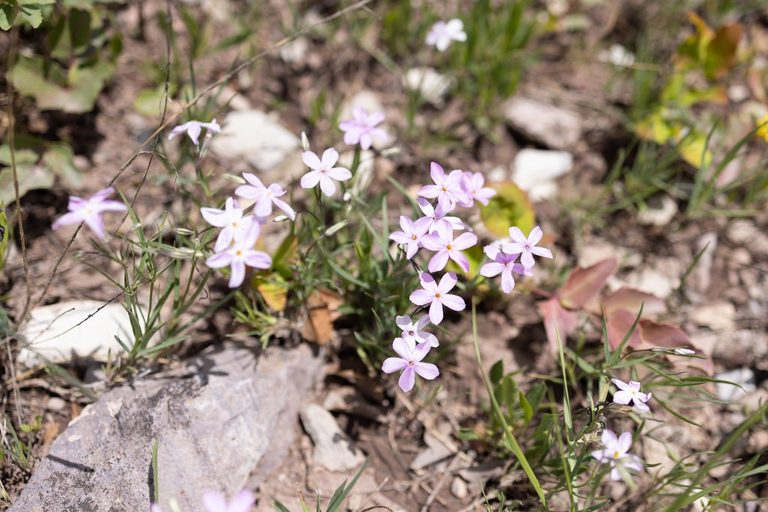
In early spring and into mid-summer, nearly every hillside and sagebrush flat in the valley becomes decorated with blooms. Wildflowers in the Greater Yellowstone Ecosystem usually bloom from May through September. According to Grand Teton National Park (GTNP), there are only about 60 continuous frost-free days a year in Jackson Hole, so the growing season is very short and the dominant blooming flowers change quickly from week to week.
Wildflower Zones
[Our region] can be separated into three distinct zones: the sagebrush valley, the forest floor and the alpine zone, says GTNP. Skyrocket gilia, larkspur and indian paintbrush bloom in the valley as temperatures rise. Flowers like fireweed, columbine, monkshood and the rare calypso orchid enjoy the moist environments found in forests. The flowers of the alpine zone grow close to the ground and the flowers are very small; examples include moss campion, alpine forget-me-not and sky pilot.
From Snow King to Death Canyon to the top of the tram, a few minutes on any trail can expose a hiker to a wide variety of wildflowers. Below, see 10 of the most common flowers spotted in and around Jackson Hole. All of these flowers can be found below 10,000 feet and some have been seen only 20 minutes from downtown Jackson.
Sticky geranium, also known as cranesbill, is an early spring flower. It can be found in open woods or meadows and last from June until August. One-flowered little sunflowers can easily get confused with a common sunflower or balsamroot. Lupine grows in colorful clumps everywhere from sagebrush flats to lodgepole forests. Silvery lupine is a ubiquitous flower in the Greater Yellowstone Ecosystem.
Columbian monkshood, cow parsnip, rocky mountain columbine, green gentian, silky phacelia, paintbrush, and balsamroot are some of the other wildflowers found in the area. Each of these flowers has unique characteristics and can be found in different zones of the park.
Original reporting: Buckrail (Jackson WY) — read the source article.