Fairfield, Conn., celebrated a sweeping victory on Election Day as Democratic candidates secured representation at every level of government. The town, once a Republican stronghold, now sends Democrats to the U.S. House, the state Senate, and the state House.
Local leaders attribute the shift to grassroots focus
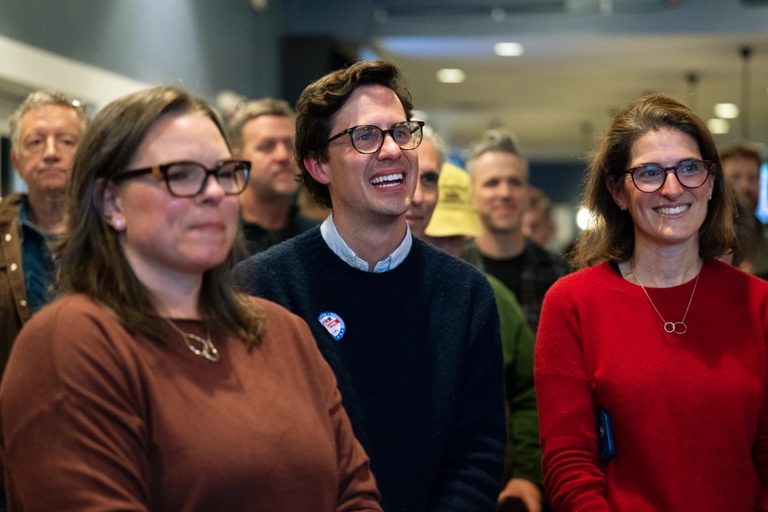
Fairfield Democratic Town Committee Chair Erin Lopez told a cheering crowd at a local restaurant that the win was the result of a decade‑long effort. “We started with Cristin McCarthy‑Vahey as our only Democratic representative,” Lopez said. “Over the last ten years we’ve chipped away, and now we have full Democratic representation at every level in Fairfield.”
Rob Blanchard, who captured the 28th district State Senate seat for the first time since 1974, echoed that sentiment. Blanchard highlighted his campaign’s emphasis on affordability and hyper‑local concerns, especially the controversial UI monopole project. “You can’t just be a Democrat that says I’m not Trump; elect me,” he said. “I’m going to stand up to the utilities and fight things like the monopole project.”
Newtown also flips a state House seat
Nearby Newtown saw Democrat Michelle Embree Ku defeat a Republican incumbent for a state representative seat, adding to the regional trend.
Analysts question the role of New York transplants
Political science professor Jonathan Wharton of Southern Connecticut State University cautioned against over‑attributing the results to recent migration patterns. He noted that while many residents have moved in and out of Connecticut, it can take time for newcomers to become politically active. “It was a bump, but it wasn’t anything significant per se,” Wharton said. “Maybe in some districts more than others, but I don’t think it was such a wide‑ranging number that we saw this overall impact for the entire state.”
Wharton also pointed to registration data showing a surge in unaffiliated voters – from just over 700 in 2020 to more than 17,000 in 2026 – while both Republican and Democratic rolls declined. This trend mirrors similar patterns in Stamford and Newtown.
National politics and President Trump’s influence
Lopez and other local Democrats cited President Donald Trump’s unpopularity in Connecticut as a factor energizing voters. Blanchard added that national sentiment helped drive turnout for Democratic candidates in the 28th district.
State Representative Cristin McCarthy‑Vahey linked the local victories to broader “kitchen‑table politics,” noting that federal policies, including $2 billion in cuts to welfare programs, have directly affected residents’ daily lives. “People understand that these impacts are having an effect on their day‑to‑day lives, on being able to fill their tanks, being able to heat their houses, being able to pay for food and medicine,” she said.
Demographic shifts and the “Blue Wave”
Lopez also highlighted an influx of liberal New Yorkers who moved to Fairfield County during the COVID‑19 pandemic, suggesting that many younger voters who previously identified as Democrats in Brooklyn now bring that affiliation to Connecticut. “A lot of them came up to Fairfield, and I think that has made a difference with younger Democrats who maybe weren’t as aware of the local politics, but were Democrats in Brooklyn, and became Democrats in Fairfield,” she explained.
She added that the extreme version of the MAGA movement has driven away some small‑c conservatives who are uncomfortable with the party’s social‑issue positions. “This extreme version of MAGA has driven away a lot of people who are small‑c conservative, in a way, but are turned off by a lot of the social issue stuff or the cruelty coming out of the Donald Trump MAGA part of the party,” Lopez said.
The election results mark a historic realignment for Fairfield, turning a former Republican bastion into a fully Democratic enclave. Local officials plan to focus on affordability, utility regulation, and protecting residents from federal welfare cuts as they begin their new terms.
Original reporting: The Connecticut Mirror — read the source article.