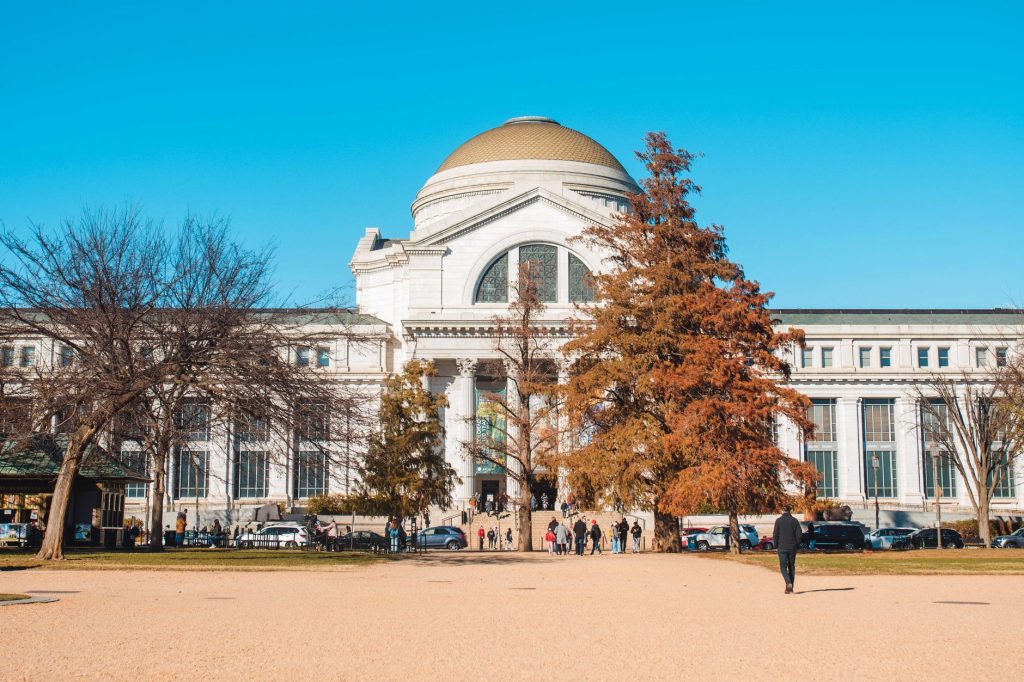
What do you actually do at a science museum when you’ve already seen the Hope Diamond and the elephant in the rotunda? Most visitors assume the answer is: leave. But on the ground floor of the Smithsonian’s National Museum of Natural History, tucked behind the Sant Ocean Hall, there’s a space called Q?rius that most people walk past without a second glance.
Q?rius is technically a learning lab — the kind of label that usually means a room with laminated worksheets and a bored docent. It isn’t. It’s roughly 10,000 square feet of open floor filled with actual specimens from the museum’s scientific collections: drawers of beetles, trays of minerals, taxidermied animals you can touch, fossil casts you can handle, and more than 6,000 real objects pulled from 145 million items stored in this building. Nothing is behind glass. Almost everything is fair game to pick up.
That’s the thing that recalibrates you. Natural history museums operate on a certain understood contract — look, don’t touch, maintain appropriate reverence — and Q?rius quietly ignores it. A kid next to me was holding a dried seahorse. Someone else was using a microscope to look at a cross-section of bone. A teenager was at a computer terminal pulling up 3D scans of skulls, rotating them like they were building something in a video game.
It opened in 2013 and is aimed, officially, at visitors 13 and up, though families with younger kids are welcome. The staff — a mix of volunteers and museum professionals — are genuinely knowledgeable and don’t hover. You can ask them to pull a specific specimen from the drawers, or you can just wander through the organized zones: Ocean, Land, Cultures, Collections. Each one is dense with real material, not replicas dressed up to look real.
The collections drawers are the highlight for me. You slide one open and find 40 pinned moths, each labeled with collection date and location. The next drawer holds shells. The next, vertebrae of something large. It gives you a sense of what the actual work of natural science looks like — not the polished exhibition version, but the accumulation that makes the exhibitions possible.
Entry is free, the same as the rest of the museum. Hours for Q?rius run 10:30 a.m. to 4:30 p.m. daily, though it can close for school groups in the morning, so mid-afternoon on a weekday is your best window if you want space to move. On weekends with families, it fills up, but it’s large enough that it never feels unnavigable.
The museum sits on the National Mall between 9th and 12th Streets NW, a ten-minute walk from the Metro Center or Gallery Place stops. Admission to everything is free.
Most people who visit the Natural History Museum leave having seen the gem hall and the ocean hall and maybe the human origins exhibit. They’ve had a good day. But Q?rius is the part that makes you feel like you’ve actually been allowed backstage — not in a performative, theatrical way, but in the straightforward sense that someone handed you a real specimen from a real collection and said, here, look closely. That’s rarer than it sounds.