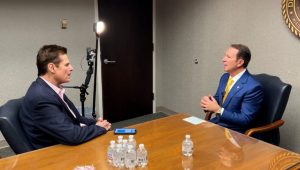
Attorney General Todd Blanche, a trusted member of the Trump administration, warned on Sunday that news outlets presenting “one‑sided” coverage pose a genuine national security risk. In an interview on ABC’s This Week, Blanche said misinformation from the White House can damage relationships with both allies and adversaries, and that the government must act to protect the nation.
Administration’s Rationale
Blanche echoed President Trump’s long‑standing criticism of media bias, arguing that false or incomplete reporting can become a security issue when it influences foreign partners. “When you have completely misinformation coming out of the White House, that affects our relationship with our foreign partners and our foreign enemies,” he said.
The Justice Department has filed a court brief seeking to justify a ban on certain outlets—CNN, MSNOW and Politico—citing the same concern. The filing claims that the outlets’ reporting has repeatedly presented a skewed narrative that undermines the administration’s ability to conduct diplomacy and protect American interests.
Judicial Pushback
Federal Judge Timothy Kelly, overseeing the case, ordered a temporary restoration of credentials for the affected journalists, finding that the revocation lacked “constitutionally adequate due process.” The judge also described the government’s national‑security argument as “routine” and said the cited articles offered little evidence of a genuine threat.
“Nothing in the record that predates this suit suggests that the revocation of Plaintiffs’ hard passes was motivated by national security concerns,” Kelly wrote. He noted that President Trump’s public statements focused on alleged falsehoods and negativity rather than a direct security rationale.
Administration’s Response to the Ruling
Despite the judge’s order, the White House has continued to limit certain press privileges. CNN journalists were barred from flying on Air Force One for a scheduled trip to Tennessee, even though they remain part of the White House TV press pool. Fox News, which the administration views as more balanced, was allowed to fulfill pool duties for the President’s trip to Chicago.
U.S. Ambassador to the United Nations Mike Waltz, speaking on CNN’s “State of the Union,” reinforced Blanche’s position, describing a “negative agenda” and “media bias across the board” that must be corrected. Waltz said President Trump is “quite frustrated” with the current media environment.
What This Means for the Press and the Public
The administration’s stance reflects a broader effort to hold the press accountable for accuracy while safeguarding national interests. Supporters argue that unchecked misinformation can erode public trust and compromise diplomatic efforts. Critics, however, warn that restricting access to the White House could impede transparency and the free flow of information.
For now, the Justice Department remains committed to pursuing the ban, citing the same national‑security concerns outlined by Blanche. The case continues to move through the courts, and the administration has signaled it will not back down until it secures what it deems necessary protections for the nation.
Key Takeaways
- Attorney General Blanche frames biased reporting as a national‑security issue.
- Judge Kelly ordered a temporary restoration of press credentials, questioning the security claim.
- The White House continues to limit Air Force One access for CNN while allowing Fox News.
- U.S. Ambassador Waltz backs the administration’s call for media reform.
- The legal battle over press restrictions is ongoing.
Original reporting: KEYT (Ventura/Santa Barbara) — read the source article.