What is Armory Square, exactly? First-timers often expect a single destination — a restaurant, maybe, or a plaza with a fountain. What they find instead is something harder to summarize: a ten-block grid of 19th-century brick warehouses that has quietly become the most layered neighborhood in all of Syracuse, with a daytime life and a nighttime life that barely resemble each other.
The district runs roughly between West Jefferson Street and West Fayette, bookended by South Clinton and South Franklin. The bones are genuinely old — the buildings here date to the 1870s and 1880s, when Syracuse was a serious industrial city, and the facades still carry the weight of that era: arched windows, cast-iron details, loading dock doors converted to restaurant entrances. The Niagara Mohawk building looms at the edge, its Art Deco crown lit up after sundown in a way that looks almost theatrical against the upstate sky.
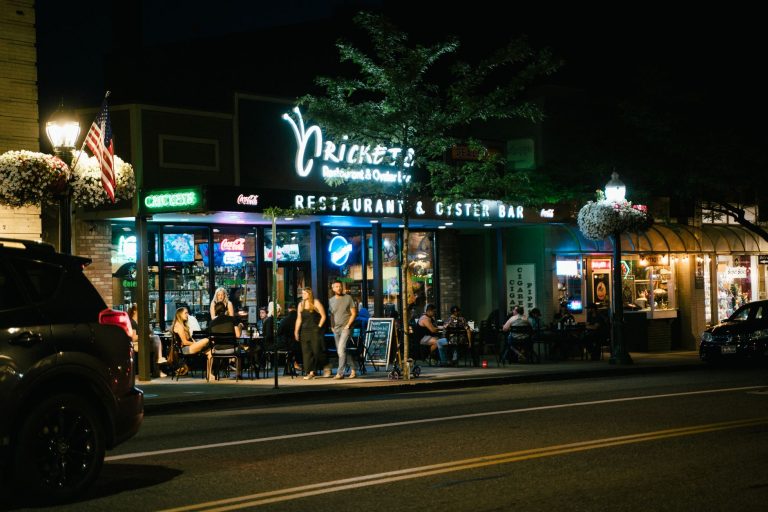
Daytime belongs to the office workers and the lunch crowd. Restaurants like Trexx and Pastabilities — wait, scratch that last one — keep the sidewalks moving from eleven onward. The stretch of South Clinton between Fayette and Jefferson is densely packed enough that a visitor can park once and spend two hours just moving between blocks on foot. In good weather, the iron tables outside spill onto the sidewalk and the whole strip takes on the kind of low-key energy that larger cities spend millions trying to manufacture.
After about seven in the evening, the neighborhood shifts register. The bars open in earnest. Club Zina draws a rotating cast of DJs. The old storefronts that serve quiet lunches become loud with music by nine. On Friday nights in particular, the corner of Clinton and Walton is the kind of intersection where four different social lives are happening simultaneously — a bachelorette party, a work happy hour, a group of Syracuse University students on their first real night off campus, a pair of regulars who’ve been coming here since the neighborhood was still being renovated in the early 2000s.
The food spread across the district is broader than any single block suggests. There’s upscale American, decent sushi, solid cocktail bars, a crepe place, a wine bar. Nothing here is going to make a national best-of list, but the concentration and the quality-to-price ratio hold up. Most dinners run $20–35 a person before drinks; the bars skew cheaper, especially on weeknights.
Parking is easier than reputation suggests. The Canal Commons garage off West Fayette handles the weekend crowds without much drama. Street parking opens up on Sunday afternoons, when the neighborhood is notably quieter — a different experience again, worth a walk just to see the architecture without the noise.
What catches a visitor off guard is how genuinely local the place feels despite its obvious appeal. Armory Square doesn’t perform itself for tourists. The regulars at the bar actually live nearby. The waitstaff at the busier restaurants have been there for years. The weekend energy is real rather than performed, which is rarer in a district like this than it should be.
Snow hits this corner of downtown like it hits everything in central New York — hard and early. But even in February, on a Thursday night when the temperature is in the single digits, Armory Square finds a way to stay occupied. That’s probably the truest thing about it.