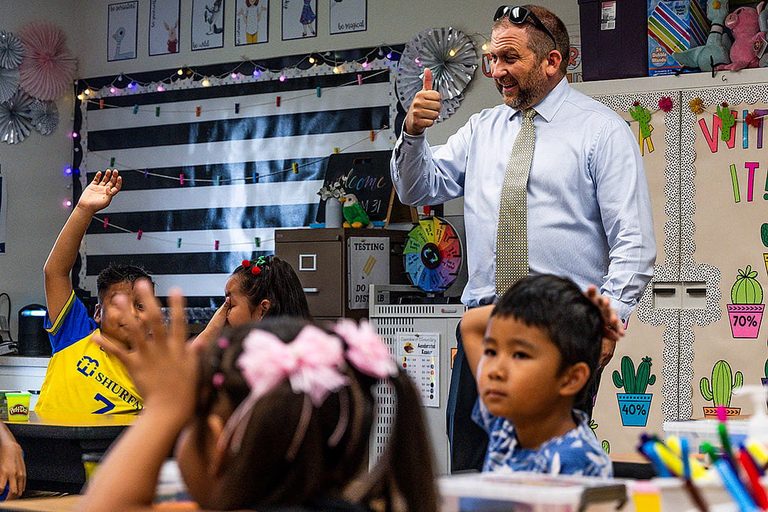
When Joel Francik took the helm of Central Elementary School in Ferndale, Washington in 2019, his background was rooted in middle‑school teaching and administration. He soon discovered that his kindergarten classrooms still resembled traditional, desk‑in‑rows settings, a model that conflicted with best practices for early childhood education.
District leadership sparks change
Superintendent Kristi Dominguez, a longtime early‑learning specialist, recognized the mismatch and flagged the need for reform. She launched a district‑wide initiative that placed principals from all six elementary schools into the National P‑3 Center’s Leadership Program, a nearly year‑long curriculum focused on child development and early learning.
The P‑3 program, originally created at the University of Washington and now housed at the University of Colorado Denver, equips school leaders with the knowledge to redesign classrooms for children from pre‑K to third grade. Participants learn that play is not idle time but a powerful vehicle for math, language, social‑emotional growth, and fine‑motor skill development.
Classroom transformations in Ferndale
After completing the ten‑month training (now a seven‑month format), Francik replaced individual desks with collaborative tables, allowing students to move, choose activities, and engage in group work. He also instituted a daily hour of self‑directed exploration, followed by reflective discussions. “We are not desks in rows anymore,” Francik said. “We have a classroom where students can move and flow based on needs while still receiving academic instruction.”
Next year, the same model will extend to third‑grade classrooms, ensuring that early‑grade practices influence the entire school culture rather than being confined to the youngest learners.
Chicago’s parallel effort
Across the country, Chicago Public Schools faced a similar challenge. Principal Joyce Pae of Chicago Academy Elementary oversaw three pre‑K classrooms but lacked guidance on integrating them with the rest of the school. She joined the Building Early Learning Leaders (BELL) program, a year‑long initiative run by VOCEL, a local early‑learning nonprofit created in response to the city’s universal pre‑K rollout.
VOCEL staff heard many principals admit, “We don’t know anything about early childhood education,” and some even avoided pre‑K classrooms altogether. The BELL program pairs school leaders with coaches who conduct classroom walkthroughs, model developmentally appropriate practices, and help translate play‑based activities into measurable learning outcomes.
During one walkthrough, Pae questioned the use of interactive whiteboards for storytime. Her coach confirmed her concern, noting that children lose critical experiences—such as holding a book, turning pages, and following left‑to‑right reading direction—when stories are presented solely on a screen. The insight prompted a return to traditional read‑aloud methods that reinforce fine‑motor and literacy skills.
Why early‑grade training matters
Both programs underscore a growing national recognition that early childhood education requires specialized knowledge. As more districts add co‑located pre‑K classrooms, leaders must understand how play, social interaction, and hands‑on learning lay the foundation for later academic success.
“The biggest lightbulb for me was play‑based learning,” Francik reflected. “Play is the work of kids.” By equipping principals with this perspective, districts are better positioned to create nurturing environments that honor the developmental needs of young children while maintaining rigorous academic standards.
Looking ahead
With the Ferndale and Chicago initiatives gaining traction, other districts are watching closely. The hope is that more school leaders will seek out similar training, ensuring that every child—especially those in pre‑K through third grade—receives an education that respects their natural curiosity and supports their long‑term growth.
Original reporting: KTVZ (Central Oregon) — read the source article.