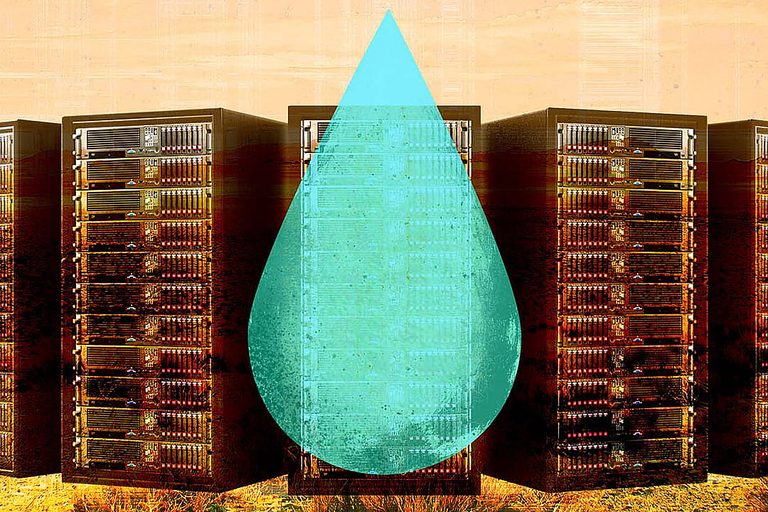
Protest signs reading “Protect our water” and “Water for people, not AI” have appeared from Texas to New Mexico to Arizona, reflecting growing local concern over the water footprint of expanding AI data centers. These facilities rely on water‑based cooling systems to dissipate the intense heat generated by high‑performance processors, which can reach internal temperatures of up to 176 °F.
Current Water Consumption
According to research cited by Knowable Magazine, U.S. data center cooling systems used roughly 66 billion liters of water in 2023—less than 1 % of the nation’s total water consumption. By comparison, agriculture and certain manufacturing sectors consume far larger volumes.
Potential Growth and Regional Impact
Experts caution that the rapid build‑out of AI‑focused data centers could raise water demand significantly. In drought‑stricken states such as New Mexico and Arizona, even modest increases may exacerbate local water stress. A study by Fengqi You of Cornell University projects that by 2030 U.S. data centers could consume between 731 billion and 1.125 trillion liters annually, a volume comparable to New York City’s annual drinking‑water supply.
Technological Advances Reducing Water Use
Recent advances are already curbing water demand. Shaolei Ren of the University of California, Riverside notes that early estimates of 500 milliliters of water per chatbot query—based on GPT‑4—are outdated as newer models become more efficient. Google reports that its Gemini chatbot now uses only five drops of water per median‑length query.
Liquid‑cooling systems, which circulate water directly around processors in closed loops, have become common among major providers such as Amazon, Microsoft and Google. Because the water is recirculated, no loss occurs under normal conditions. When extreme heat or humidity demands additional cooling, some facilities employ misting, though this represents a small fraction of overall usage.
Future Strategies for Water Stewardship
Researchers suggest several pathways to further reduce water footprints. Relocating new data centers to regions with abundant renewable energy and lower drought risk—such as Montana, Nebraska, parts of Texas and South Dakota—could limit pressure on water‑scarce areas. Additionally, shifting electricity generation toward solar and wind, which require minimal water, would cut indirect water use tied to fossil‑fuel power plants.
Emerging cooling technologies, including immersion cooling where hardware is submerged in non‑conductive liquids, promise even greater efficiency. Companies like NVIDIA report that their latest processors operate effectively at higher temperatures, allowing reliance on high‑efficiency fans rather than water‑intensive cooling methods.
Industry Commitments
Major cloud providers have set ambitious water‑positive goals. Amazon Web Services aims to return more water to communities than its direct operations consume by 2030 and reports being over halfway to that target as of 2024. Google has pledged to replenish 120 % of the freshwater its data centers use by 2030 through various stewardship projects. OpenAI also outlines plans to minimize water use on its public web page.
Local Perspective
In Texas, mechanical engineer Vaibhav Bahadur notes that most AI data centers employ water‑based cooling only during the hottest summer periods. He estimates that while current data center water use in the state is under 1 % of total demand, it could rise to 3 %–9 % by 2040 if unchecked. Bahadur remains optimistic, citing ongoing efficiency improvements.
Community leaders in Arizona and New Mexico echo similar concerns, urging developers to consider both water availability and renewable‑energy access when planning new facilities. Balancing technological growth with responsible resource management remains a key challenge for the industry.
Conclusion
Data center water consumption is modest compared with national totals, yet the rapid expansion of AI infrastructure warrants careful monitoring, especially in arid regions. Continued innovation in cooling technology, strategic siting, and a shift toward renewable power can help ensure that AI’s growth does not compromise vital water resources.
Original reporting: El Paso News (HLL/CB) — read the source article.