The father of one of the teenage gunmen involved in the deadly attack at the Islamic Center of San Diego, Marco Vazquez of Chula Vista, wrote court declarations saying he voluntarily removed all firearms and sharp knives from his home and increased supervision of his son, Caleb Vazquez. Court filings show Chula Vista police sought a gun violence emergency protective order in January 2025 after officers reported Caleb “was involved in suspicious behavior idolizing Nazis and mass shooters.” The shooting killed three people at the mosque and school and left the community reeling.
Court records say an officer wrote that Caleb “was involved in suspicious behavior idolizing Nazis and mass shooters.” That same filing noted Caleb “was placed on a 5150 hold,” and that Marco had 12 firearms registered to him, though officers could not confirm whether they were stored properly. Marco says he and his wife then removed firearms, ammunition and sharp knives from their home out of concern for their son.
In a Feb. 13, 2025 declaration Marco detailed the steps he took after police performed a welfare check and he refused officers access to a locked closet where firearms were kept. He said he provided a photo of the gun safe, the closet and a list of 26 weapons, two of which were owned by his wife, and boxes of ammunition. Marco wrote that when he tried to give paperwork showing he’d transferred guns into storage, an officer served him with a gun violence restraining order.
Marco insisted in his filing, “I have never made any threats to any individual or group,” and added, “Nor do I support anything that threatens or incites any kind of violence against any individual or group. I do not advocate for or support any violent ideology such as Nazism, racism, school shootings or mass shootings.” Those words were part of his attempt to explain the steps he and his wife took to limit access to weapons amid concerns about their son.
He described heightened oversight: the family contacted Caleb’s school, put him in weekly therapy and said they were watching him closely. Marco wrote, “My wife and I have been supervising him daily since the incident to the extent that we have stayed home for [sic] work to ensure that he is always under our supervision,” and said they monitored his online activity and interactions. The filings show parents trying multiple interventions but still worrying about what online radicalization can do.
San Diego police later said the two shooters met and were radicalized online and began seeing each other after realizing they both lived in San Diego. Investigators say the other teen, 17-year-old Cain Clark, was reported missing by his mother in a 911 call at 9:42 a.m. PT the morning of the attack; she told dispatchers her son, guns and car were missing and that he was suicidal. Police were reportedly investigating when the attack unfolded roughly two hours later.
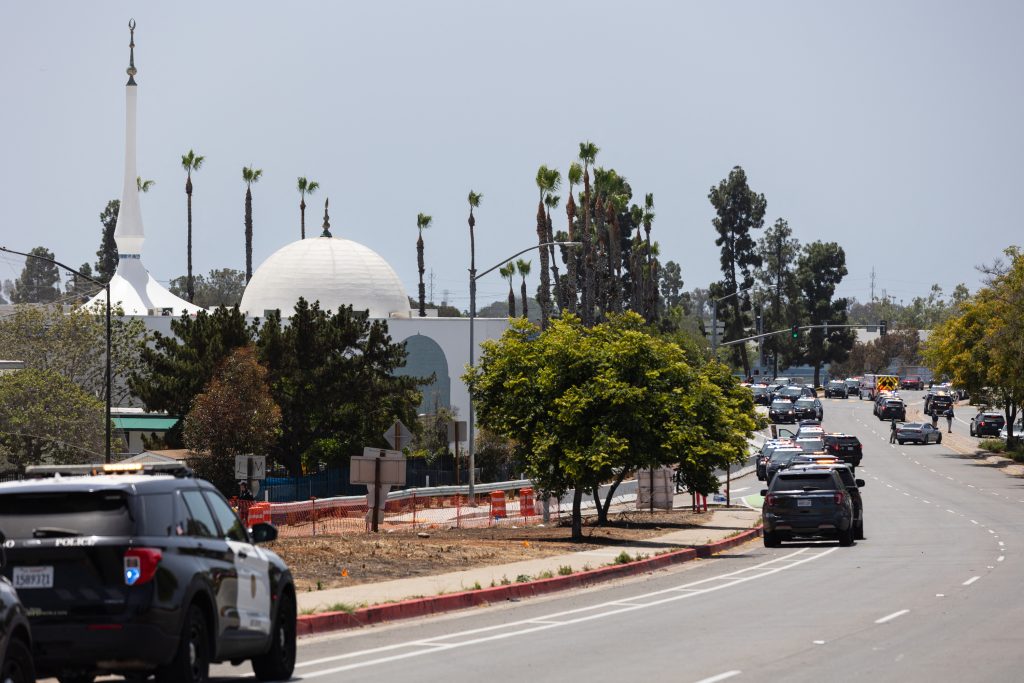
The gunmen approached the Islamic Center of San Diego, which serves as both mosque and school, and shot security guard Amin Abdullah. Abdullah returned fire and radioed a lockdown, according to accounts of the scene. Two other men, Mansour Kaziha, who worked at the center for 40 years, and Nadir Awad, who lived nearby and ran toward the shots to help, were killed in the parking lot after drawing the shooters outside.
Officials say the teens appear to have livestreamed the killings, fled and fired on a landscaper before turning guns on themselves. The FBI reported the suspects left behind writings filled with extremist views targeting many groups. The victims’ actions, especially Abdullah’s, were credited with limiting further loss of life during the attack.
The Vazquez family released a statement saying they were “heartbroken and devastated.” “We want to begin by acknowledging that nothing we say or do could ever repair the damage his actions have caused,” the family wrote. “We condemn these hateful and violent actions entirely. As much as we mourn the child we raised and love, we mourn even more deeply for the innocent lives of Amin Abdullah, Mansour Kaziha, and Nadir Awad. We honor and thank them for their heroic actions that day, which prevented the loss of even more innocent lives. Our hearts and prayers are with each of their families during this unimaginably tragic time.”
The family noted Caleb was on the autism spectrum and said they believed he had been exposed to “hateful rhetoric, extremist content and propaganda” online that they feel “contributed to his descent into radicalized ideologies and violent beliefs. While there is no excuse for his actions, we have come to recognize how dangerous online spaces are that normalize hatred,” the statement continued. They described multiple attempts to get him help, including rehab and supportive placements, and said they will “forever live with the burden of wondering whether there was more we could have done to help prevent this senseless tragedy.”