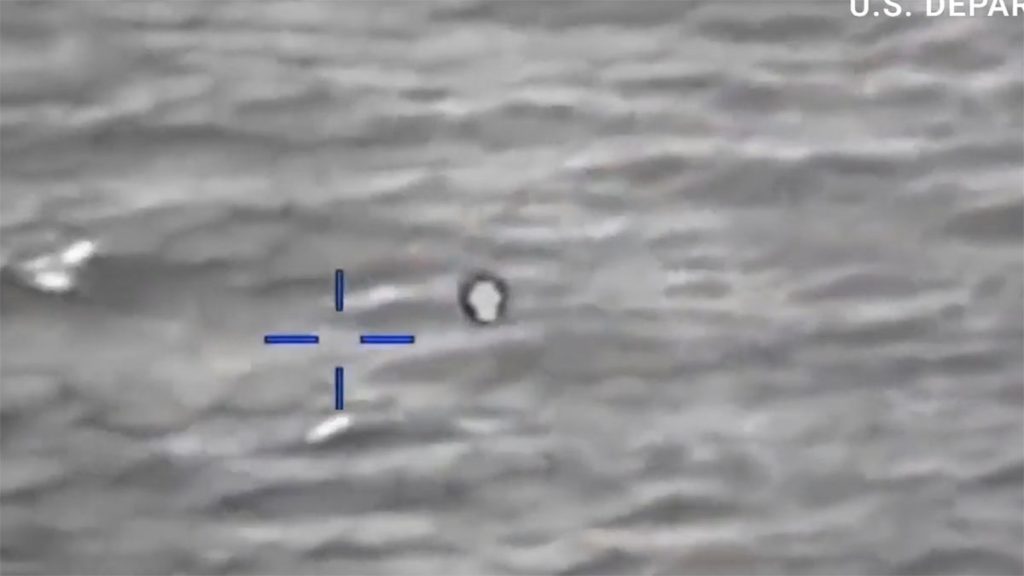
The newly released government files describe a string of unexplained aerial incidents from a U.S. intelligence helicopter encounter to astronaut audio from Project Mercury, naming figures like Scott Carpenter and referencing places from Los Alamos to Lake Huron; the documents, declassified in a recent batch, include military footage, notes and redactions meant to protect witnesses and locations.
A senior U.S. intelligence officer recalled a late-2025 helicopter mission investigating strange “thuds” near a mountain range and encountering an orange orb that split and altered course. “The ground team suddenly radioed that the object had risen from the ground, approached within ten feet of the helicopter, dropped below us and sped away,” the officer wrote in a memo included in the files. Fighter jets were scrambled, and observers noted the orbs matched the jets’ speed and flight path, even seeming to “chase” them for a time. “We were virtually speechless after these observations,” the memo says, and no definitive explanation followed.
The documents come mainly from the Department of Defense, with additional materials from NASA and a single file attributed to the CIA, covering incidents from the 1940s through roughly six months ago. The files are heavily redacted to shield witnesses and sensitive information, and officials explicitly warned readers not to treat the papers as conclusive judgments about what the events were. The release adds to a growing public record of encounters that military personnel, pilots and scientists have reported over decades.
Among the older accounts is a handwritten letter from a Los Alamos scientist who wrote about green lights seen intermittently between 1948 and 1951 in the nearby mountains, sometimes appearing to move in formation. Another file recounts a 1972 sighting by a CIA officer in the former USSR who stepped outside after a sports event and observed a widening green circle with concentric rings. Video clips in the cache show spherical, oblong and cigar-shaped objects moving across land, sea and open sky, often captured as grainy trackings that remain puzzling to analysts.
Some of the footage points to activity in multiple countries, with clips originating from Kabul, Syria, Kazakhstan and locations across Europe. Near Kazakhstan’s Karaganda International Airport, a recording shows a burst of oval white light lighting the night sky, and another European clip appears to show an object that stops and starts in a jerky, controller-like way. In the United States, clips from November 2020 and the following spring reveal circular objects moving through cloud layers and across central airspace, while separate footage captures objects floating near a surfaced submarine.
The material also includes a case from 2023 in which a fast-moving object was shot down over Lake Huron; officials have not made clear whether that debris was recovered or conclusively identified. Audio tracks span decades and include NASA pilot reports from the 1960s and 1970s describing odd particles and observations made during historic missions. Those recordings illustrate that unexplained phenomena are not a new feature of aerospace operations but a recurring thread in flight logs and mission reports.
Project Mercury audio provides an evocative example. In 1962, as Scott Carpenter orbited the Earth during the mission, he described seeing what he characterized as small particles moving in and out of view. “Their motion is random. They look exactly like snowflakes to me,” Carpenter says in the crackling transmission, an exchange that prompted ground control to question whether he had attempted to return. “Roger, have you tried to return?” ground control asks, and “Negative,” Carpenter responds calmly as he says he has to adjust and sees particles again.
Beyond the sensory reports and video clips, analysts will need to weigh instrumentation limits, atmospheric oddities, misidentified aircraft and classified technology among other possible explanations. The government’s statement accompanying the release warned readers not to treat the documents as analytic conclusions, and the files themselves include caveats that preclude treating redacted notes as proof of any particular origin. Still, the accumulation of accounts from trained observers—intelligence officers, pilots, scientists—forces a sober look at recurring, unexplained sightings.
The timing of the declassification came amid a week of other major headlines, including international developments and legal moves that dominated news cycles. The files nonetheless refocused public attention on whether unidentified anomalous phenomena can be systematically investigated, cataloged and understood with current intelligence tools. For now, officials point to redactions, limited context and an absence of definitive attribution as reasons the materials do not settle the debate.
What stands out in the packet is the variety of reports: handwritten notes, cockpit audio, grainy infrared clips and debrief memos describing objects that sometimes accelerated, split, pulsed with light or matched military aircraft maneuvers. The records cover civilian and military encounters, and they underscore a persistent gap between raw observation and verified explanation. Researchers and skeptics alike will likely comb the files for patterns, but the documents themselves stop short of offering final answers.