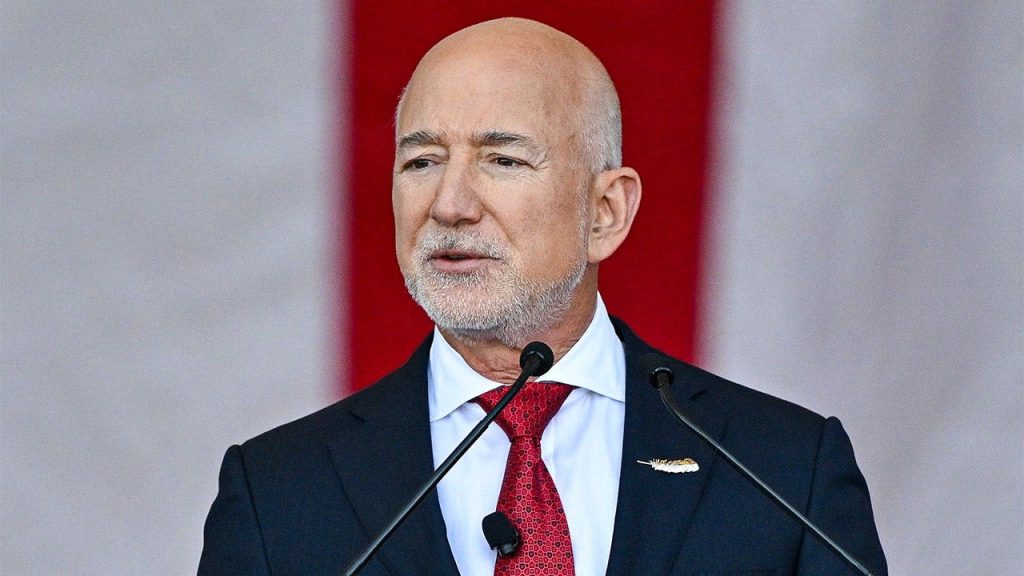
Jeff Bezos faced tough questions about the Washington Post’s sweeping layoffs in a CNBC interview with Andrew Ross Sorkin, defending cuts as necessary for the paper’s survival while pledging to protect investigative work. The exchange touched on staff reductions across sports, metro, books, foreign correspondents and photojournalism, the Post’s financial struggles, past growth under Bezos and the paper’s recent Pulitzer for coverage of the Trump administration. Bezos argued relevance and paying readers matter, Sorkin pushed back about subsidy expectations, and the fallout from editorial decisions — including a pulled endorsement of Kamala Harris in 2024 — still hangs over the title based in Washington, D.C.
The staff reductions shocked many in the newsroom and the wider industry, hitting longstanding beats and veteran roles. Sports, metro and books desks were pared back alongside foreign correspondents and photojournalists, a painful contraction for journalists whose work helps define the paper’s reach. Management acknowledged heavy losses were an ongoing problem, but that didn’t make the gut-punch any easier for colleagues who had built careers at the Post.
Sorkin laid out the public reaction plainly when he asked, “The company laid off about 30 percent of its staff, and there are a lot of people out there who said, ‘Jeff’s super wealthy, he’s talked about this being a public trust, something that he bought early on, how much you care about that piece of it. Why lay people off? Why fire people? Why don’t you subsidize the business?'” The question echoes a common expectation: owners with deep pockets should cushion legacy outlets, especially when journalism plays a public role. For Republicans and others who worry about institutional influence, though, ownership and editorial direction raise extra scrutiny.
Bezos answered directly: “The Post needs to be a profitable enterprise that stands on its own two feet,” and he reiterated the longstanding argument that a paying audience validates what a news outlet produces. He’s one of the richest people on earth — an Amazon founder with an estimated net worth of around $270 billion, according to Forbes — so his insistence that the paper run like a business cut against intuition for some observers. Still, Bezos framed paying subscribers as a market test for relevance rather than a problem to be papered over by wealth.
Sorkin pressed the philosophical point: “But does it? Some people say it should be a trust,” and Bezos took that on with a practical line. “Let me tell you why. It’s a measure of its relevance. If people won’t pay for our product, it’s not a good enough product,” he said, tying editorial ambition to consumer demand. “It would be like poetry without rhyming. It’s too easy,” Bezos added, suggesting that a free pass would dull the paper’s edge.
Bezos even compared the Post to rivals, noting that The New York Times “makes a ton of money.” He argued the Post can do the same: “You guys are doing very well financially, and you’re providing a service that people are willing to pay for. We can do that, too.” That line underscores the tension between journalistic mission and the commercial reality of the subscription era, a debate playing out at major outlets across the country.
On the layoff process itself, Bezos said he didn’t personally choose who left. “Follow the data,” he said. “Follow the data, and I said there is one exception to this… don’t follow the data on investigative reporting.” He stressed that investigative work is the paper’s core, calling the “heart of the Post is investigative reporting,” and promising protections for that unit even as other areas shrink. It’s a pledge that matters because deep reporting has produced some of the Post’s most consequential journalism.
Bezos also defended the size of the newsroom in historical context. “Our newsroom today, after the layoffs, is still larger than when we did Watergate and the Pentagon Papers,” he said, using those benchmarks to argue the institution has scale and stamina. He pointed to a recent Pulitzer Prize for Public Service in 2026 for the Post’s reporting on the Trump administration’s efforts to reshape government as evidence the outlet still produces first-rate work. Those are weighty claims, and supporters will point to prizes while skeptics will watch staffing and coverage areas for signs of decline.
When asked whether he wanted to own the paper, Sorkin pushed on conflicts of interest: “Do you want to own it? And the reason I ask is you’ve talked about how you are, by default, to some degree a conflicted owner, given you own all of these other businesses,” the CNBC host asked. Bezos said the paper was unprofitable when he bought it in 2013 for $250 million and detailed a turnaround: “When I bought The Post, it was very unprofitable when I brought it. The newsroom was even smaller than it is today. We turned it around in two years, it was profitable for six years. I put all that money back in The Post and grew the newsroom, so we’ve shrunk it back some now. But we haven’t shrunk it back to what it was when I bought it,” he said. That history matters to anyone weighing the future of the title.