Dallas leaders say a sweeping, two-year effort to improve safety and revitalize downtown is showing measurable progress as the city prepares to host millions of visitors for the FIFA World Cup this summer.
At a news conference on Wednesday, officials with the “Safe in the City” initiative highlighted declining crime, a sharp reduction in street homelessness and billions of dollars in new development, while unveiling a new downtown command center for the Dallas Police Department.
NBC 5 got an exclusive look at the new offices as officers toured the space for the first time. The space is located at Radiance Plaza across from City Hall, which will serve as the first dedicated home for the department’s downtown patrol division.
“Throughout our search for the ideal location, Radiance Plaza kept coming back as the clear answer. This building is our statement that Safe in the City is not a program with an expiration date. This is permanent,” said Downtown Dallas Inc. President and CEO Jennifer Scripps.
Until now, the unit has operated largely out of patrol vehicles and temporary locations in the downtown area. Around 120 authorized Dallas PD officers are dedicated to the central business district.
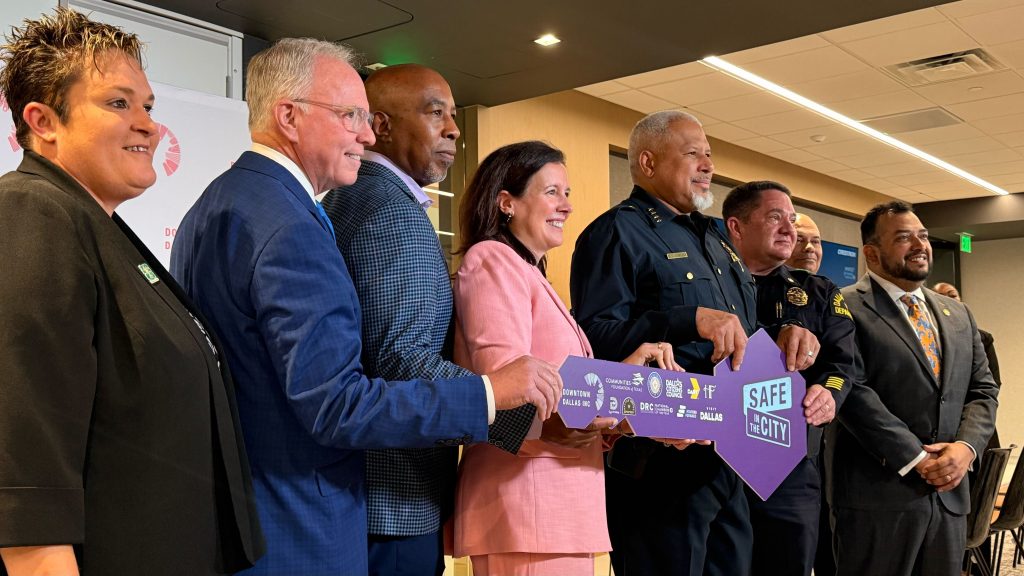
City leaders also presented a ceremonial key to the police during the event.
“What happens downtown impacts the entire city,” Dallas Police Chief Daniel Comeaux said. “Over the past year, we’ve built a stronger downtown safety strategy with more visibility, proactive policing and a dedicated downtown division.”
The Command Center represents the first phase of a longer-term vision to pursue a fully functioning Downtown patrol division — similar in structure and capability to Dallas’s seven existing patrol divisions. Major John Madison, DPD’s Downtown Commander, will serve as the first commanding officer of the facility.
The new division offices are funded for at least three years with nearly $1 million in private investment from the Dallas Citizens Council and the Dallas Regional Chamber, part of a fund that also includes additional support from the Communities Foundation of Texas and the Hoblitzelle Foundation.
TWO-YEAR PROGRESS REPORT
The Safe in the City initiative was launched about two years ago, focusing on three pillars: public safety, homelessness and economic vibrancy.
According to officials, violent crime in downtown Dallas is down 16% year-to-date, while non-violent crime has dropped 7%. DART Police, a partner in the effort, also reported reductions, including a 17% decrease in crimes against persons and a 28% drop in property crimes compared with the same period last year.
In addition to expanded patrols, the program includes 24-hour security coverage and new infrastructure such as upgraded surveillance cameras.
Scripps said the initiative was born out of mounting concerns about safety, visible homelessness and declining foot traffic.
“Downtown needed a significant increase in law enforcement presence, continued coordination on homelessness, and a renewed level of investment,” Scripps said. “We went to work and we had some tough conversations, but we all stayed aligned.”
Officials say one of the most significant changes has come in addressing homelessness. Leaders announced that all known encampments in the downtown core have been permanently resolved, with hundreds of people connected to housing through partnerships with Housing Forward and other groups in the ongoing ‘Street to Home’ effort.
Street homelessness in the area has declined by about 87% since the program began, according to officials.
“We aligned homeless Outreach with behavioral health specialists and shelter access, housing pathways and law enforcement under one umbrella, and one coordinated strategy. And the results are remarkable,” said Sarah Kahn, CEO of Housing Forward, which is the lead agency for the homeless response system in Dallas. “I think really reflects something that’s rare in big city policy. We had a partnership that was very intentionally designed and executed with discipline and actually resulted in real change for community members.”
The coalition also noted the launch of Phase 2 of the Street to Home initiative, a $28 million commitment to scale the Downtown homelessness response model across Dallas and Collin counties, funded by $20 million from the City of Dallas and Dallas County plus a private match.
“The goal is not simply moving people out of town, but actually moving people on a pathway, towards stability so that they can exit homelessness permanently. And so this really became our proof point for what we want to do across Dallas County,” Kahn said. “I think we are really proving that when we align partners around a clear model and hold each other accountable for results, that we can really move the needle on one of the most complex challenges that our community is facing.”
DOWNTOWN ‘FACELIFT’
Alongside safety improvements, the city has invested heavily in beautification projects aimed at improving the downtown experience. Crews have planted nearly 500 trees, enhanced lighting, refreshed signage and covered vacant storefronts with public art.
“We have a hard time envisioning how Dallas can and the region can fulfill its full potential without a vibrant core. There’s no city in America. There’s no city around the world that prospers without a vibrant core,” said Rob Walters with the Dallas Citizens Council.
Officials say more than $8 billion in development and redevelopment is underway or planned in downtown Dallas, with office leasing activity also on the rise.
With Dallas set to host nine matches during the FIFA World Cup and serve as a hub for international media, leaders said the initiative has taken on added urgency. A FIFA fan festival and International Broadcast Center will also be based in or near the downtown area.
“We are getting our house ready,” Scripps said. “Making Downtown welcoming isn’t just about security and crosswalks and lighting, it’s about old-fashioned hospitality, too.”
From this Friday, May 22, through July 19 for 39 days, officials say Main Street will be activated daily through a partnership with Better Block — featuring expanded pedestrian space, shade structures, and programming for World Cup visitors.
Still, city and business leaders emphasized that the effort is designed to extend well beyond the global event.
“We did not build this infrastructure and these partnerships only for FIFA, but it’s given us a great deadline and motivation to bring us here today,” said Scripps. “We built this for downtown’s long term, for the people who live here, work here and own businesses here. The World Cup just happens to be our best opportunity to show the world what we’ve built.”
Officials said the goal is to establish a lasting standard for safety and livability in Dallas’ urban core, one they hope will continue long after the World Cup crowds leave.
“While FIFA is important and I’m a big fan of football, our investment was not driven by FIFA. It was driven by the impact that we’re going to have on the humans and the citizens of Dallas,” said Wayne White, President & CEO of Communities Foundation of Texas. “North Texas is what we focus on. Dallas is the core. It’s the heart. And having a safe, vibrant, inclusive downtown is key to our overall success.”
This story uses functionality that may not work in our app. Click here to open the story in your web browser.