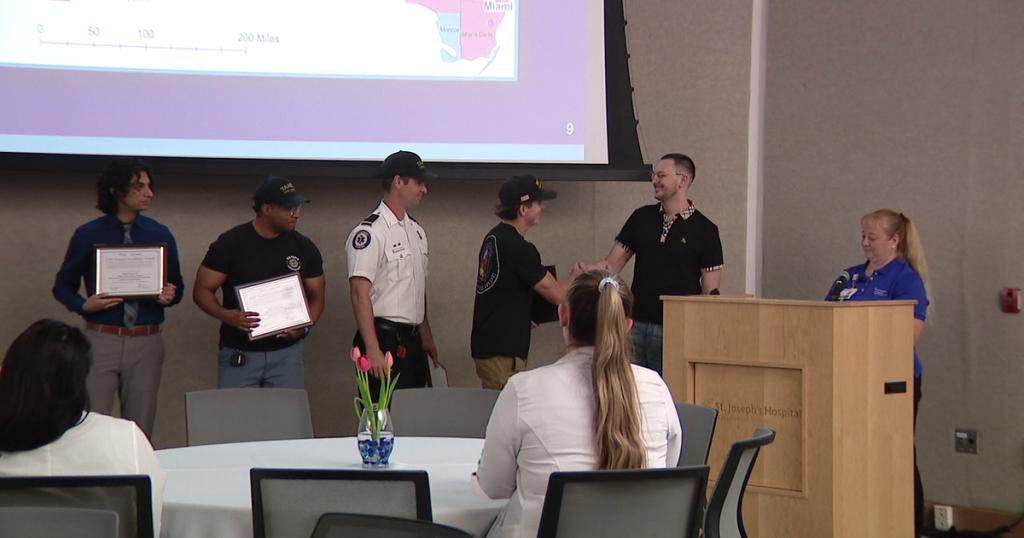
Connor Dietrich reunited with his family and the St. Joseph’s Hospital trauma team in Tampa to thank the paramedics, surgeons and nurses who pulled him back from the edge after the deadly Ybor City crash last November. His parents, Bob and Karen Dietrich, joined Dr. Donald Straub and other caregivers for a National Trauma Survivors Day event where they spoke about the crash, the months of recovery and a future Connor now dreams about in emergency medicine. The crash, linked to driver Silas Sampson, left four people dead and dozens injured, and Connor’s story has become a public example of resilience and gratitude in Tampa.
Connor’s recovery reads like something out of a medical drama, except it’s real and still unfolding. He suffered a traumatic brain injury that doctors described as life-threatening and, for a time, the medical team feared he might never wake up. Through surgeries, intensive care and months of therapy, he regained consciousness and slowly rebuilt basic skills, proving the physicians and therapists who tended him right when they held onto hope.
Family members kept a steady vigil while the trauma team managed a crisis that could have ended very differently. “I mean, he’s a miracle,” Bob Dietrich said, capturing how surreal and grateful the family felt when progress finally arrived. Karen Dietrich echoed that awe in the blunt, emotional language parents use when the unthinkable becomes survivable: “He is a walking, talking miracle.”
Connor himself hears the miracle talk often, and he has gotten used to the label even as he pushes forward with recovery tasks and procedures. “I’ve been told many times that I’m kind of a walking miracle,” Connor said, matter-of-fact and humbled. He remembers only the fragment of the night of the crash: “I remember hearing what sounded like [a] tire squeaking or something like that, and I turned around and I kind of cursed because I saw a car coming, but that’s the only thing that I remember. After that is all black,” Connor Dietrich said.
The scene in Ybor City that November grew chaotic when a vehicle entered a crowd outside Bradley’s on Seventh. According to investigators, Silas Sampson was fleeing troopers on Interstate 275 at speeds exceeding 90 miles per hour before exiting toward Ybor City and plowing into pedestrians. Four people were killed, and Connor, his brother and a friend were among 13 others who survived but suffered injuries.
At St. Joseph’s, trauma surgeons and staff had hard conversations with the Dietrich family during the first critical days. “He [Connor] had a very severe brain injury. And for a few days, we had the discussions that he may not recover,” Straub said, blunt about the stakes they faced. Those discussions and the relentless care that followed were part of what made the reunion so charged, with surgeons and nurses seeing the arc from near-loss to active recovery firsthand.
Emotions ran high during the public thank-you because so much of the early period felt uncertain and raw. “I’m emotional, you know, you try not to be, but you just are, because I got my son and I didn’t think I’d have him,” Bob Dietrich said, voice catching as he stood before the people who helped save Connor. For the trauma team, watching a patient regain function is more than clinical success; it’s a human payoff after long shifts and impossible decisions.
“You develop an attachment to people. I think you get to know them really, really well. So, yeah, it’s really refreshing to see somebody come back and have recovered in such a short period of time,” Straub said, reflecting on what the team experiences when a patient like Connor begins to heal. That attachment and the hard work behind it are precisely what National Trauma Survivors Day is meant to spotlight—both the progress of survivors and the care that made it possible.
Connor still faces more surgeries and ongoing rehabilitation, and the hard miles of recovery are not over. He says following doctors’ orders and seeing steady gains motivates him to keep going: “Every time I do what they’re telling me to do, I see the progress and I can feel myself getting better,” Connor said. The experience has also steered him toward a new career path; he now hopes to work hands-on as a paramedic and eventually become a physician assistant so he can help others in emergency situations.