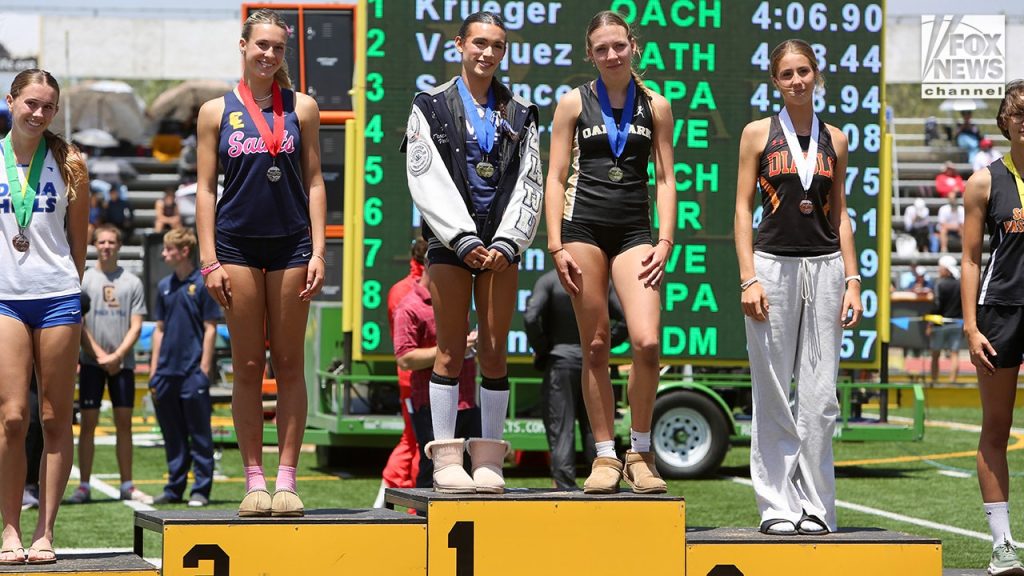
AB Hernandez’s sweep of the high jump, long jump and triple jump at the CIF Southern Section finals in Moorpark has reignited a statewide fight over fairness in girls’ sports, with Crean Lutheran’s Olivia Viola and other competitors pushing back in California as the season heads toward State Finals in Clovis. Jurupa Valley High School’s senior Hernandez claimed top spots across the postseason meets, and the CIF’s co-champion policy has left female athletes and parents feeling sidelined while the U.S. Department of Justice and state officials trade legal and political blows.
On national television Olivia Viola spoke plainly about the frustration many girls feel when governing bodies apply procedural fixes instead of real solutions. Dana Perino spoke with Olivia and her mother: “Olivia, sorry for what you’re going through. Riley Gaines posted this: ‘If you have to create a shared podium for the boy competing in the girls’ event, you’ve already admitted you know he isn’t a girl and that his participation is unfair. At that point, you’re just seeking a public humiliation ritual for the girls.'”
Viola told viewers the CIF’s co-champion rule is limited to postseason state qualifiers and does not solve the broader problem that female athletes face all season long. “I would say it’s nothing but a band-aid fix from the athletic governing board. It doesn’t actually undo all of the displacements that have happened throughout their entire league. It only applies to the final CIF meets. It doesn’t apply to league, it doesn’t apply to outside meets, it doesn’t apply to other sports. It doesn’t actually fix the problem; it’s just a blanket to keep us quiet.”
The CIF policy elevates the top biological female finishers to identical placements whenever a transgender athlete finishes ahead of them, a move intended to avoid stripping titles while still recognizing girls who placed next. That compromise has produced widely shared images of Hernandez standing on the top step alongside female athletes, which only deepens the argument that the underlying competitive imbalance is being papered over. Critics say that visual sameness on a podium does not restore lost opportunities, scholarships or the psychological impact of displacement.
Girls competing across California report being displaced in league meets, invitationals and dual meets where the postseason co-champion rule has no effect, leaving many coaches and athletes scrambling for fairness at the local level. Parents describe seasons where results, records and morale are affected long before anyone reaches Moorpark or Clovis. The patchwork approach creates a season-long disadvantage that can’t be fixed by a medal reallocation at the end.
CIF points to California Assembly Bill 1266, the 2013 law that requires schools to let students participate consistent with their gender identity, as the legal framework behind current policy. Governor Gavin Newsom’s office has called protests against Hernandez a cynical attempt to weaponize a cultural debate, defending the state’s compliance with existing law. Yet the federal government has pushed back, and after Hernandez’s strong postseason results last year the U.S. Department of Justice filed a Title IX lawsuit that places California’s athletic rules squarely in federal court.
The dual-advancement and dual-medal system works only in certain track and field events and does not map cleanly onto wrestling, football, or other contact sports, which leaves glaring inconsistencies across schedules and rulebooks. Coaches and athletic directors warn that what looks like a compromise in one sport becomes a logistical and legal headache in another. Those inconsistencies are fueling calls for uniform state or federal standards that prioritize competitive fairness for biological female athletes.
From a Republican standpoint the argument is straightforward: girls deserve a level playing field and rulemaking bodies should respond to biological realities rather than political pressure. Athletes like Olivia Viola are asking for protections that keep female competition meaningful and safe, not for public spectacles that pretend fairness has been restored. Lawmakers and courts now face a choice between preserving women’s sports as designed and allowing policies that effectively reassign titles and opportunities.
As the season moves toward State Finals in Clovis, protests and legal filings will likely increase, and local leagues will remain battlegrounds where wins, losses and personal records matter most to athletes chasing scholarships and recognition. Families, coaches and conservative advocates are mobilizing around rallies and legal strategies to press for change at both the state and federal levels. The next weeks will test whether California will stick with its current pathway or be forced to adopt rules that clearly protect girls’ sports.
For now the debate continues to play out in stadiums from Moorpark to Clovis and in courtrooms and newsrooms across the country; athletes like Viola are refusing to accept cosmetic fixes while others demand consistent, sport-by-sport solutions. Follow the conversation on X: @alejandroaveela