A large protest in Manhattan spilled through Washington Square Park and up to Times Square as organizers, including the Muslim American Society and Within Our Lifetime, led chants calling to “globalize the intifada.” New York Mayor Zohran Mamdani condemned a separate federal terror indictment tied to Mohammad Baqer Saad Dawood Al-Saadi the same afternoon, and well-known activists like Nerdeen Kiswani and Abdullah Akl took visible leadership roles. Gaza-related flags and militant symbols, including Hamas and Hezbollah emblems, were flown openly as demonstrators staged a highly orchestrated march across midtown Manhattan.
About 500 people gathered with Palestinian flags, pre-printed banners and professional signage in Washington Square Park, where chants of “globalize the intifada” broke out and speakers rejected Israel’s legitimacy. Organizers turned a corner of the park into a rally zone and then moved through the city in what looked like a planned procession. The timing coincided with news that federal authorities had charged an alleged Kataib Hezbollah operative, bringing a tense political backdrop to the demonstration.
The mayor’s statement landed just as the crowd was assembling: “Let me be clear: antisemitism, violent extremism, and terrorism have no place in our city. This kind of hate is despicable,” Mamdani
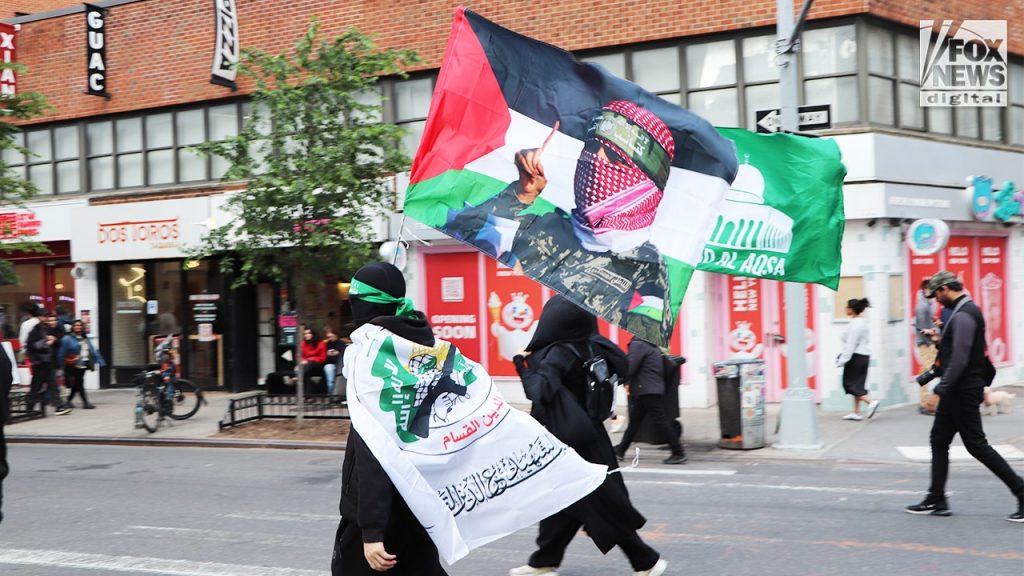
Some demonstrators carried imagery tied to Hamas, including a young man draped in the Izz ad-Din al-Qassam Brigades flag and a banner showing Abu Obaida, the Hamas military spokesman killed in 2025. Others displayed Hezbollah’s yellow flag with its distinctive insignia. Those visuals prompted unease among bystanders who expected a protest focused on policy, not militant iconography.
The event was organized and amplified by local groups that have been active in New York for years, notably the Muslim American Society and Within Our Lifetime. Activists arrived with stacks of professionally printed signs, banners and drum kits, turning the march into a polished public performance rather than an impromptu street demonstration. That level of coordination mattered as the crowd moved through high-visibility spots like Grand Central and Park Avenue.
https://x.com/NYCMayor/status/2055384200300183898?s=20
Nerdeen Kiswani took center stage near the Washington Square Arch and led the crowd in loud, repeatable chants: “Globalize the intifada! From New York to Gaza! Globalize the intifada!” Her rhetoric left no ambiguity about the movement’s goals and repeatedly rejected the existence of the state of Israel. Kiswani said bluntly, “We do not mince words here,” and declared, “I do not and will never recognize Israel’s so-called right to exist. It has no right to exist.”
Shortly after, Abdullah Akl stood in front of a large banner reading “GLOBALIZE THE INTIFADA” and invoked a slogan that many interpret as calling for Israel’s elimination: “From the river to the sea.” He followed that with, “Palestine will be free.” Those lines echoed through the march as protesters prepared to move uptown in a tightly managed formation.
Organizers did not appear to police the display of militant flags. Hamas flags stayed visible throughout the route, often directly behind key speakers, despite public claims to the contrary. When asked about the banners, Kiswani repeated, “We only bring Palestinian flags,” yet the images of armed fighters and explicit militant insignia remained in plain sight.
Participant messaging ranged widely across the crowd. Some groups marched under the banners of Al-Awda and Marxist organizations such as the Freedom Road Socialist Organization and the Workers World Party, creating an unusual coalition of Islamist and leftist activists. Flyers distributed at the march mixed calls for armed resistance with invitations to unrelated community organizing, underscoring the diverse makeup of the protest ecosystem.
Members of the Orthodox Jewish community also joined the demonstration carrying signs that read “Judaism condemns the state of Israel” and “Torah demands all Palestine,” and Rabbi David Feldman offered a personal theological take: “They don’t target against Jewish people, so I don’t think that they are a terrorist group. They’re just fighting for the land, what people stole from them, that’s all. So that’s what I believe, so I don’t say anything in politics, that is all.”
Some participants defended the imagery as free speech. One protester, Anas Shuayb, 27, described the Hamas symbols as a form of resistance and framed the displays as protected expression. He also identified as a Trump voter and said, “I’m Palestinian and a Palestinian who voted for Trump,” adding sharp criticism of U.S. foreign policy choices affecting the region.
At moments the crowd created the appearance of a street takeover, briefly surrounding vehicles and chanting “Shut it down” while NYPD officers rerouted traffic. Protest marshals managed movement and legal observers kept pace, indicating the march was planned for maximum impact and media visibility. The organizers timed stops at prominent city locations so chants and visuals would appear in many photographs and videos.
As the march reached Times Square, protesters staged a public prayer under large flags, a final act meant for wide social-media distribution. The young man in the Hamas cape positioned himself among those leading the prayer, the Qassam Brigade iconography visible as worshippers prostrated. The night left a clear image: a city intersection repurposed into a curated political theater.
The demonstration highlighted a debate about public safety, free speech and where lines should be drawn when symbols of militant groups appear in civic spaces. For many New Yorkers, the show of flags and the explicit calls against Israel’s existence crossed a line from protest into provocation. City officials and residents will be left to weigh how to balance protections for protest with the risk of normalizing violent imagery on crowded streets.