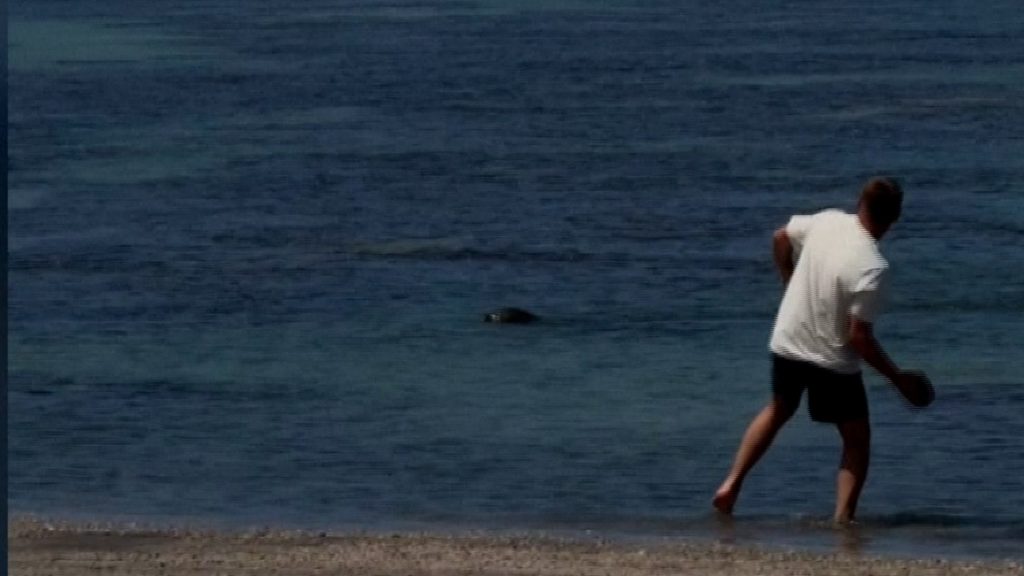
A visitor identified as Igor Mykhaylovych Lytvynchuk, 38, of Covington, Washington, was arrested after a video showed him throwing a coconut-sized rock at Lani, a well-known Hawaiian monk seal off a beach in Lahaina, Maui, and federal agents moved in to charge him with harassment of a protected animal while prosecutors prepared a criminal complaint and a Seattle court appearance was scheduled.
Federal prosecutors in Honolulu have charged Lytvynchuk with harassing and attempting to harass an endangered Hawaiian monk seal, and National Oceanic and Atmospheric Administration special agents arrested him near Seattle. The U.S. attorney’s office in Honolulu announced the case and said he was due to appear in U.S. District Court in Seattle, where the docket initially showed no attorney listed for him. Local authorities in Maui began the inquiry after a tip and a witness who preserved a cellphone video for investigators.
The complaint includes a scene captured on shore where, as prosecutors put it, “In the cellphone video, the man can be seen holding a large rock with one hand, aiming, and throwing it directly at the monk seal.” According to that account, the rock narrowly missed the seal’s head but caused the animal to abruptly alter its behavior, a key detail that marks the incident as interference rather than an accidental disturbance. Witnesses on the sand confronted the man, and their statements have been folded into the formal complaint sent to federal court.
One witness reported the man offered a flippant response when challenged, saying “he did not care and was ‘rich’ enough to pay any fines,” the complaint said. That remark is now part of the record and helps paint a picture of intent and attitude that prosecutors can use when pursuing charges under the Endangered Species Act and the Marine Mammal Protection Act. Statements like that also feed public outrage and drew attention from elected officials in Maui and beyond.
Maui Mayor Richard Bissen weighed in publicly, calling the charges a clear signal that cruelty toward protected wildlife will not be tolerated and stressing what Lani’s presence has meant to residents still recovering from last year’s catastrophic wildfire. “Lani is a reminder that humanity and the instinct to protect what is vulnerable are still values people can unite around,” Bissen said in an emailed statement, linking the seal’s return to a fragile period of community healing. The mayor said he contacted the U.S. attorney in Honolulu to urge vigorous prosecution.
Hawaiian monk seals are critically endangered, with roughly 1,600 animals left in the wild, and federal statutes carry steep penalties for harassment of such protected species. If convicted, Lytvynchuk faces up to one year in prison for each count, plus fines that can reach $50,000 under the Endangered Species Act and as much as $20,000 under the Marine Mammal Protection Act. Those potential punishments are meant to act as both retribution and deterrent against people who get too close or act aggressively toward marine wildlife.
The initial field investigation was handled by a state Department of Land and Natural Resources officer who responded after someone reported the disturbance in Lahaina, a community that suffered devastating losses during the 2023 wildfire. That officer took the witness video and later coordinated with federal partners when the footage showed what officials judged to be an intentional throw. From there, NOAA special agents took the lead in locating and arresting the suspect near Seattle, showing how state and federal agencies can link up across jurisdictions.
Video evidence has become central to wildlife protection cases, and this incident highlights how bystanders and visitors can become the crucial witness needed to trigger enforcement. Authorities relied on that cellphone clip to lay out the facts in the criminal complaint, and prosecutors used the details—aiming, throwing, and the seal’s sudden behavioral change—to justify the harassment counts. The incident underlines the legal and ethical responsibility people have when they encounter endangered animals on beaches or in the water.
The court system will now take its course in Seattle, where charges must be proven beyond a reasonable doubt and where defense attorneys can challenge evidence, context, or intent. Meanwhile, conservation groups and local officials in Maui are likely to keep pressure on prosecutors to pursue the case fully, since high-profile incidents like this one can influence public awareness and enforcement priorities. Regardless of the outcome, the episode has prompted fresh conversations about visitor behavior, wildlife safety protocols, and how communities protect vulnerable species.