At least 500 of Connecticut’s estimated 35,000 soldiers serving in the Revolutionary War were Black, according to military records. One of these men, forcibly taken from either Africa or South America to Connecticut in the mid-1700s, was a physician known as Doctor Cuff Saunders.
Doctor Cuff Saunders’ Story
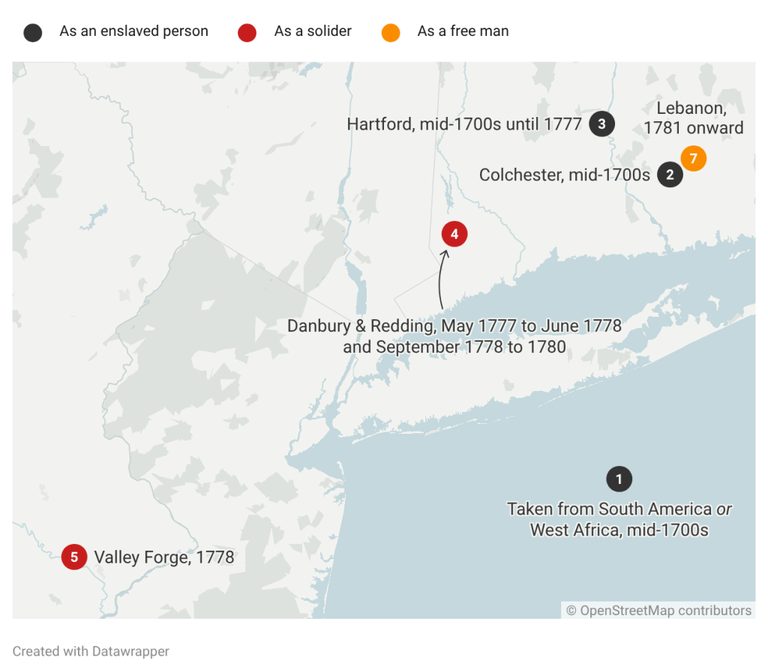
Saunders’ occupation was rare: Black soldiers often worked as cooks, orderlies and trench-diggers. Before the war, Saunders had been bound to an apothecary in Colchester and a doctor in Hartford, records show. He enlisted as a private in the 4th Connecticut Regiment in 1777 to earn his freedom.
His medical skills likely caught the attention of his commanding officers, as he spent most of his service in Danbury assisting Philip Turner, surgeon general of the army’s eastern division, with medical procedures and preparing medicine.
Black Soldiers in the Revolutionary War
Historical data compiled by Forgotten Voices reveals that Saunders and 180 other known Black or Indigenous soldiers were also stationed at the Redding Encampment — sometimes referred to as “Connecticut’s Valley Forge.” From June to September 1778, personnel documents also describe Saunders as tending the sick at the actual Valley Forge in Pennsylvania.
In 1777, Connecticut passed two laws that incentivized slaveowners to send Black soldiers into war. Any two men who could “procure an able-bodied soldier” for enlistment were exempted from the draft. And slaveowners who freed enslaved people were no longer required to financially support them.
Kevin Johnson, a member of Connecticut State Library’s history and genealogy department, has portrayed Black historical figures involved in the Revolutionary and Civil Wars for 28 years. He draws on extensive archival research to ensure audiences leave “feeling” the humanity of the individual.
Johnson cited freedom as the main reason Black soldiers enlisted, but emphasized the many meanings of the word. “Their own personal freedom definitely was the main reason,” he said. “For some, it was patriotism for the land that enslaved them. … They were willing to die for it.”
During the war, many enslaved soldiers began dropping the last names of their enslavers and choosing their own. Last names such as “Freeman,” “Freedom” and “Liberty” pepper historical records, reflecting the promise of freedom extended to enslaved soldiers by slaveowners and the Revolution alike.
But life after the war revealed the limits of freedom without support. “Most people did receive their [manumission] and were free, but they didn’t really have anywhere to go, because they didn’t have any wealth or extensive family lines,” said Dana Meyer, digital projects manager at the Connecticut League of Museums.
Saunders died from influenza in 1788. In 1837, his wife Phillis, twice-widowed, applied for a pension. It took six years for her application to pass, perhaps due to administrative lags or skepticism surrounding her marriage to Saunders.
Original reporting: The Connecticut Mirror — read the source article.