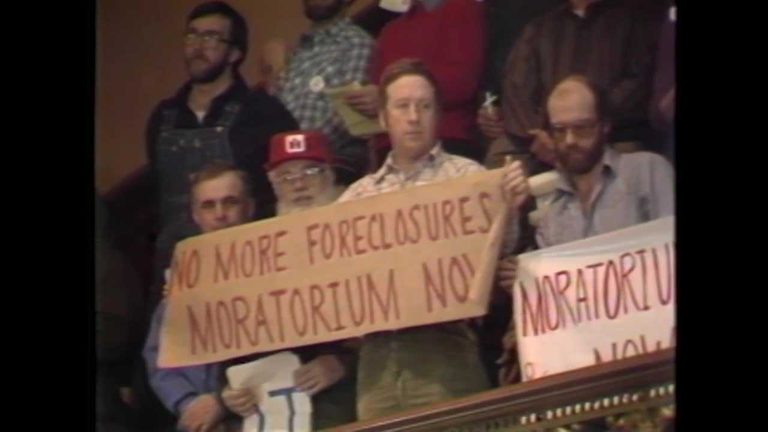
The 1980s farm crisis had a profound impact on rural Iowa, forcing many families to lose their farms and altering the landscape of agriculture and food production. Brian Sampson, an Iowa farmer, reflected on the legacy of his family’s farm, which has been in his family for generations.
A Crisis Triggered by Soaring Interest Rates
The crisis was triggered by soaring interest rates, which left farmers with adjustable-rate mortgages struggling to keep up. According to Pamela Riney-Kehrberg, an Iowa State University distinguished professor of history, many farmers who had adjustable-rate mortgages suddenly discovered that they might have a mortgage rate as high as 24%.
Sampson, who was in his 20s at the time, recalled the toll it took on his father. Many farmers were unable to make payments, leading to foreclosures and auctions. In 1983 alone, there were about 500 farm auctions a month, according to the Associated Press.
A Lasting Impact on Rural America
The loss extended beyond land, deeply impacting farmers’ identities. The crisis worsened, and family farms were sold by sheriffs on courthouse steps, often near white crosses symbolizing each farm lost. Roughly 25% of families lost their farms in Iowa, according to Riney-Kehrberg.
Despite the hardships, the Sampson family persevered. Brian Sampson now sees his son, Bryce, continuing the family tradition. Farming today is more business-oriented, requiring close attention to finances. However, the lessons of the 1980s have brought a shift in attitudes, with people now feeling more comfortable with the idea of saying, ‘I need help,’ Riney-Kehrberg said.
Original reporting: KOAT Albuquerque — read the source article.