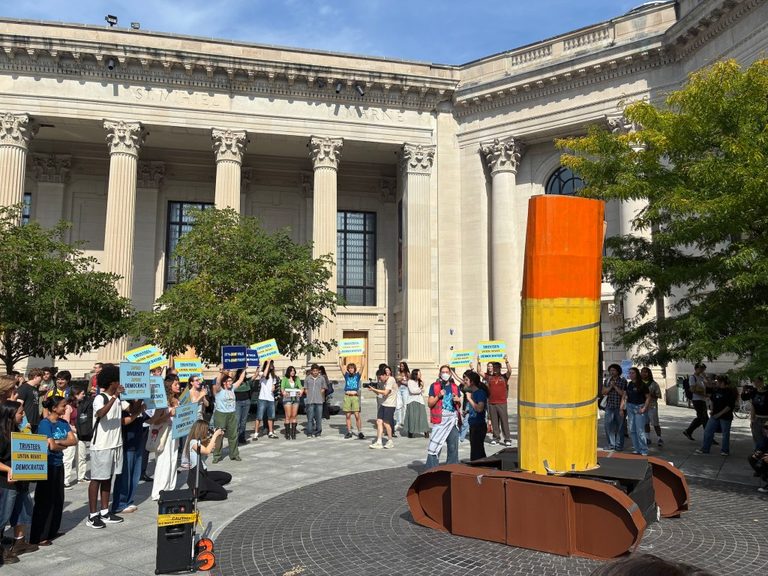
On Friday afternoon, hundreds of Yale students assembled on Beinecke Plaza around a cardboard replica of Claes Oldenburg’s iconic Lipstick statue. The demonstration, the largest on the plaza since 2024, was organized by the student group Democratize Yale to demand that the university halt settlement negotiations with the Trump administration over its admissions practices.
Protest Targets Settlement and Campus Speech Rules
Students argued that the settlement would compromise academic integrity and undermine the university’s commitment to independent admissions decisions. They also condemned recent campus policies that require prior registration and permission for any outdoor structures, labeling the rules “restrictive and arbitrarily enforced.” Those regulations were adopted after a series of pro‑Palestine protests in 2024 that led to dozens of arrests by Yale police.
“Yale’s policies today ban peaceful student protests and demonstrations without the university’s express permission,” said architects Sam Callaway and Stuart Wrede, who designed the replica. “What is Yale afraid of?”
Elected Officials Join the Demonstration
U.S. Representative Rosa DeLauro and U.S. Senator Richard Blumenthal attended the protest, speaking alongside Mayor Justin Elicker and several Yale faculty members. DeLauro praised Yale as a bastion of “freedom of thought, diversity, and innovative solutions,” while Blumenthal expressed distrust of the administration’s handling of the settlement, stating, “The response I’ve received, in a letter back to me, was essentially, trust us. I’m not willing to trust the administration in Yale with our freedom.”
Law professor Amy Kapczynski added that the university faces a “concerted attack” on education from the president and vice president, who seek to control curricula. She warned that such interference threatens the core mission of higher‑education institutions.
University’s Position
Yale President Maurie McInnis confirmed in July that the university is in ongoing talks with the Department of Justice regarding admissions. A university spokesperson reiterated Yale’s longstanding practice of not commenting on active legal matters but affirmed the school’s commitment to follow the law, maintain academic freedom, and keep admissions and hiring decisions independent.
In a September 24 email to the Yale College Council, McInnis emphasized that “our fidelity to academic freedom is absolute” and that faculty must retain full freedom in research, teaching, and publishing.
Student Reaction and Ongoing Mobilization
Students expressed mixed feelings about the settlement news. Conor Webb, a junior with the Yale College Democrats, said the protest helped slow the settlement’s progress. “From all angles, there’s a very clear message that we feel our values are not being represented in the discussion room,” said John Robert Walker, a junior with the Endowment Justice Collective.
Democratize Yale also called for reforms to Yale’s trustee selection process, urging the university to open voting to a broader segment of the community. The group pledged to continue mobilizing until their demands are met, noting that the recent surge of student energy offers a hopeful contrast to a national climate where university administrators often shy away from defending students, faculty, staff, and alumni.
Context of Federal Involvement
The proposed settlement with the Trump administration reflects the federal government’s ongoing effort to enforce admissions laws and ensure that institutions comply with legal standards. While critics on campus view the settlement as an overreach, the administration’s involvement underscores a commitment to uphold the Constitution’s guarantee of equal opportunity and to protect the integrity of higher‑education admissions.
As the debate continues, Yale’s community remains divided over how best to balance academic freedom, federal oversight, and student expression.
Original reporting: New Haven Independent — read the source article.