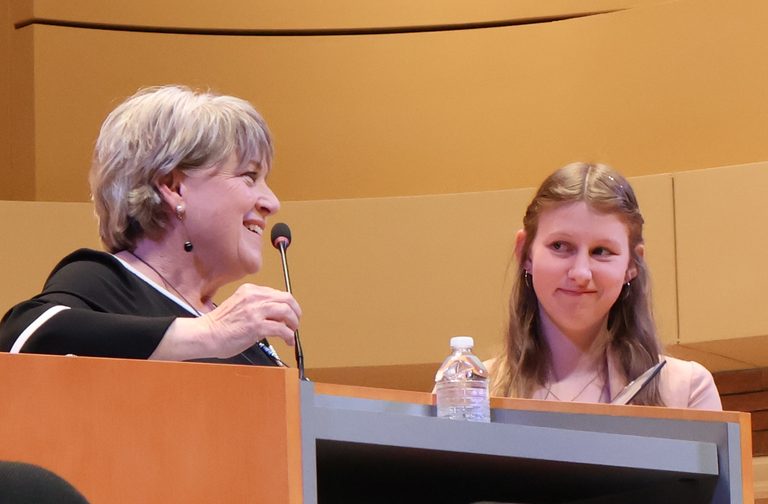
CASPER, WY — The five justices of the Wyoming Supreme Court gathered at Casper College’s Wheeler Concert Hall this week for their annual outreach. While hearing oral arguments in the active trust dispute Hurd v. Hurd, the justices also highlighted the achievements of local student Miraim Washout, who rose above 8,000 competitors in the inaugural Presidential 1776 Award competition and earned a meeting with President Trump.
Trust case and courtroom discussion
The trust case centers on assets from a marital trust created by a couple married 45 years, each with children from prior relationships. The husband died in 2023, naming his son as sole trustee shortly before his death. Both sides agree there is no material fact in dispute, but the parties differ on the trust’s language. The widow’s counsel argues the trust unambiguously directs distribution to her, while the son’s counsel points to provisions suggesting a broader administrative role.
Justice John G. Fenn questioned the interpretation of the term “either,” noting its potential to affect the court’s analysis. Widow’s attorney Kevin K. Kessner responded that the term does not materially impact the decision.
Student honored for civic achievement
Chief Justice Lynne Boomgarden praised Washout, saying she represented Wyoming’s humility and authenticity. “Miriam did us so proud because she was so authentically humble and ‘from Wyoming’ and soft‑spoke,” Boomgarden said.
Washout’s victory in the national civics competition required answering questions on the Federalist Papers, constitutional principles, and early democratic writings—topics even the justices admitted would be challenging to answer on the spot.
In a statement released by the Wyoming Department of Education, Washout quoted Eric Liddell, saying, “God made me for a purpose, but he also made me fast, and when I run I feel his pleasure.”
AI and court administration
Justice Boomgarden addressed audience questions about artificial intelligence, noting that AI‑generated case citations have appeared in filings and some attorneys have faced sanctions for inaccurate references. She emphasized existing rules to punish sloppiness and lack of candor, adding, “If you are not using AI to your clients’ advantage, you’re probably committing malpractice.”
The justices also discussed the courts’ role among the three branches of government and recent political climate concerns, referencing the Wyoming Supreme Court’s 2024 decision striking down state abortion bans.
Community engagement
The event concluded with a public Q&A, where the justices fielded questions on legal terminology, AI, and the balance between legal soundness and public perception. Their presence underscores the court’s commitment to transparency and education within the Casper community.
Original reporting: Oil City News (Casper WY) — read the source article.