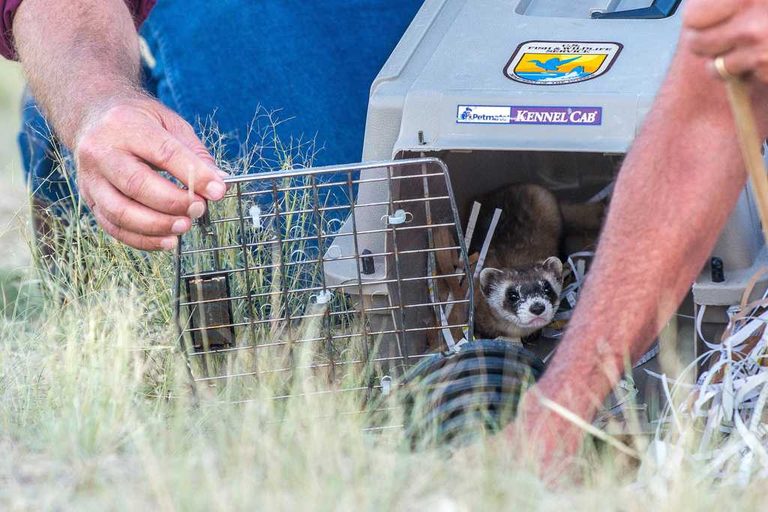
Wyoming wildlife officials say the black‑footed ferret population reintroduced near Meeteetse remains undetected after extensive summer surveys. Small‑carnivore biologist Andy Gygli of the Wyoming Game and Fish Department spent several hundred hours searching 4,000‑5,000 acres but found no ferrets.
Plague and drought drive the decline
Sylvatic plague outbreaks in 2018, 2019 and again in 2023 have repeatedly decimated prairie‑dog colonies, the primary prey for ferrets. The 2020 survey recorded only a single ferret, and a modest release of 18 captive‑raised animals in 2022 temporarily boosted numbers before the 2023 plague resurgence. By 2025, only one ferret was observed, and none this summer.
Rancher and community response
Local rancher Allen Hogg, whose family’s ranch was the historic site of the species’ 1980s rediscovery, expressed disappointment but cautioned that absence does not prove extinction. “I’m really disappointed, of course,” Hogg told WyoFile. “They might be gone. But just because they didn’t find them doesn’t mean they’re not there, either.”
Prairie‑dog habitat under stress
Drought across the Bighorn Basin has reduced vegetation, limiting food for prairie dogs and, consequently, for ferrets. Gygli noted that prairie‑dog colonies shrank from over 6,000 acres in 2016 to about 3,800 acres after the 2023 plague event, with lower densities per acre.
Management actions and future plans
To protect remaining prairie‑dog colonies, wildlife managers redirected ten captive‑raised ferrets slated for Meeteetse to the Shirley Basin, where a successful reintroduction has been documented. The goal is to lessen predation pressure while prairie‑dog numbers recover.
Annual prophylactic insecticide treatments aimed at flea control—costing roughly $100,000—are applied to about 4,000 acres each year, with the majority of funding provided by the Bureau of Land Management.
Gygli remains optimistic that continued habitat improvement could allow a future release in 2027, provided prairie‑dog populations rebound sufficiently.
Historical perspective
The Meeteetse area was the cradle of the black‑footed ferret’s rescue in the 1980s, when a ranch dog’s discovery led to the capture of 124 wild individuals. After a series of plague and canine distemper outbreaks, the last known wild ferret was taken into captivity in early 1987, leaving only the Meeteetse ranch as the species’ sole source.
Despite the bleak current outlook, the Wyoming Game and Fish Department says it will continue to work in the Meeteetse foothills, honoring the historic role the area played in saving the species.
Original reporting: WPBF West Palm Beach — read the source article.