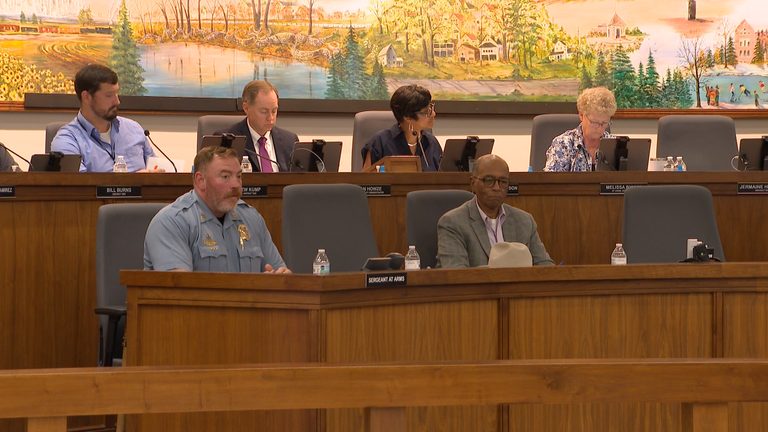
At a Unified Government (UG) commission meeting on Thursday, Wyandotte County residents and officials pressed the state of Kansas to justify its role in the $3 billion Kansas City Chiefs stadium project. The county filed a lawsuit claiming the Kansas Sports Facilities Authority Act (House Bill 2466) unlawfully strips local governments of the power to tax, zone, and provide utilities for projects overseen by the community‑owned Board of Public Utilities.
Community concerns surface
Long‑time resident and Chiefs fan Scott Harding expressed frustration that the team’s owners should shoulder more of the cost. “I love the Chiefs, but they’re among the richest people in the world. They could pay for it,” Harding said.
Former mayor and former chief of staff for County Executive Christal Watson, Frank Ramirez, attended the meeting with low expectations. “I was expecting another disappointment, to be completely honest with you. Talk is cheap; actions are what’s important,” Ramirez said. He added that he hopes the community’s voice is finally being heard and not used as a political strategy.
Official response
County Executive Watson defended the commission’s stance, stating, “We’re just doing what’s in the best interest of our community.” After a unanimous vote, the UG moved forward with the lawsuit, emphasizing the need for local control over any tax or utility arrangements tied to the stadium.
Expert analysis points to a broader shift
Dr. Michael Smith, a political‑science professor at Emporia State University, noted that Wyandotte County feels sidelined by the state’s negotiations. “In Wyandotte County, the state kind of went around them and negotiated this. They haven’t been sold on it yet,” he said.
Smith said the growing skepticism mirrors a national trend: voters are increasingly wary of stadium projects that promise economic growth but often divert existing revenue. “Sports economists have been saying for years these projects do not pay for themselves. They divert revenue that could be used for something else,” he explained.
He added that local voters are feeling the pressure of inflation, rising housing costs, and grocery prices, leading them to scrutinize large public‑private deals more closely. “When Jackson County voters turned down a sales tax that started this whole stadium relocation fight, it signaled a shift,” Smith observed.
Financial stakes
The Chiefs have pledged to cover 40 percent of the stadium’s $3 billion price tag, leaving the remainder to be funded through a combination of public financing and private contributions. The UG’s lawsuit seeks to ensure that any additional public funding does not come at the expense of essential services or unfair tax burdens on residents.
Looking ahead
Smith warned that future stadium proposals will face higher expectations for transparent benefits. “We haven’t seen our last stadium deal, but there will be much higher expectations to prove the benefits to the community moving forward,” he said.
The UG’s legal challenge underscores a growing demand for local input on large‑scale projects and reflects a broader national conversation about the role of taxpayer money in sports infrastructure.
Original reporting: KSHB 41 Kansas City (local) — read the source article.