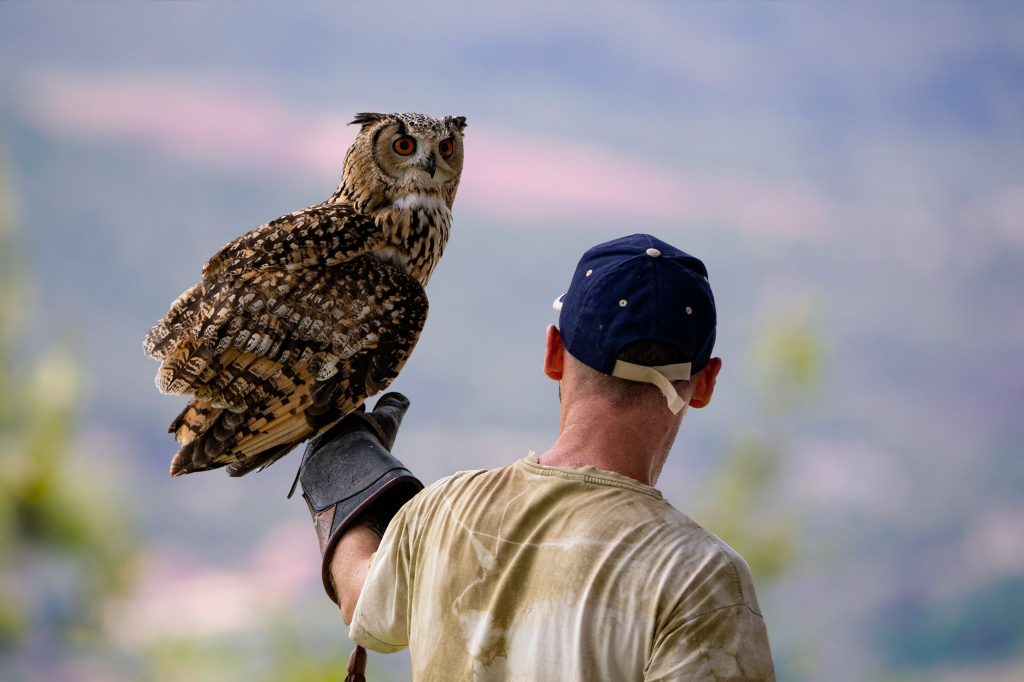
There is a moment, standing just a few feet from a great horned owl perched on a weathered wooden post, when the bird fixes you with that ancient, amber-eyed stare and you feel genuinely humbled. That moment happened to me at Owl Creek Raptor Rehab & Education Center, tucked into the rural fringe southeast of Fort Wayne, and I have been thinking about it ever since.
Owl Creek is not a zoo, and that distinction matters. It is a working wildlife rehabilitation facility dedicated to rescuing, healing, and — whenever possible — releasing injured birds of prey back into the wild. The raptors you encounter here are the ones who could not be fully returned to the wild, whether from a permanent wing injury, imprinting on humans, or another condition that makes independent survival impossible. They have become what the staff call education ambassadors, and the title suits them perfectly.
On the day I visited, a knowledgeable volunteer walked our small group through the outdoor mews — the individual enclosures housing red-tailed hawks, a barred owl, a kestrel, a turkey vulture, and several other species. She spoke about each bird with the kind of familiarity you develop over years of daily care. You learn quickly that these are not props or performers. They are individuals with personalities, quirks, and histories. The kestrel, North America’s smallest falcon, has a tendency to show off. The turkey vulture, a bird most people reflexively dismiss, turns out to be gentle, curious, and surprisingly endearing up close.
What sets Owl Creek apart is how transparently educational it all feels without ever becoming a lecture. The center runs programs for school groups, Scout troops, and community organizations throughout the year, and they welcome curious adults just as warmly. The staff are passionate without being preachy, happy to answer every question you can think of — about migration patterns, prey habits, the mechanics of silent owl flight — and a few questions you never knew you had.
The setting itself adds to the experience. The grounds are quiet and unhurried, surrounded by open farmland and mature trees, the kind of place where you naturally slow down and pay attention. Plan to spend at least ninety minutes, though two hours passes effortlessly. Admission is modest, and every dollar goes directly toward the rehabilitation work happening behind the scenes.
Fort Wayne sits at the edge of genuine agricultural and woodland habitat, and Owl Creek is the organization quietly doing the unglamorous work of keeping that ecosystem intact, one recovered hawk at a time. Whether you are bringing children who need to understand why wildlife matters or you are an adult who simply wants an afternoon that feels genuinely meaningful, this place delivers on both counts.
Call or check their website before visiting to confirm public hours and any scheduled programs, as availability can vary by season. The drive out is straightforward, and the reward waiting at the end of it is extraordinary.