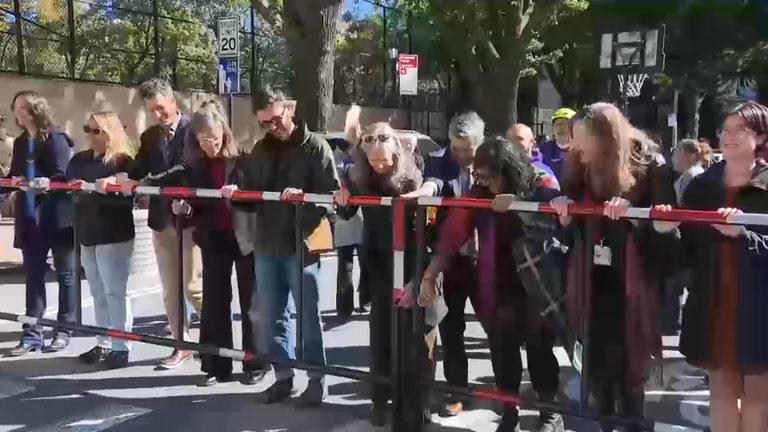
Manhattan’s West Village has launched a pilot program that temporarily closes a city block to vehicle traffic, providing a safe outdoor area for students during the school day. The swing gate, installed at the intersection of Clarkson and Hudson streets, can be locked by school officials between 10:30 a.m. and 3 p.m., creating a car‑free zone for recess, school events and supervised play.
How the pilot works
Two schools located near the gate have the option to close the street during the designated hours. City As School’s Darius Nazario explained that staff will use the space to supervise children, saying, “If I have my little ones out here or my big ones out here, you’ll see me at the gate.” The New York City Department of Transportation (DOT) Commissioner Mike Flynn called the modest gate “a ton of potential,” noting that it builds on ideas that emerged during the pandemic about alternative uses for city streets.
Community response
Local residents have praised the added play space. One longtime New Yorker, who grew up in the suburbs, said, “I always had space to play outside, so I think it’s great New Yorkers get that too.” Another neighbor highlighted the benefit for commuters, noting that the street can become hectic after work and the gate offers an added safety buffer for the school.
Traffic and funding considerations
Critics have raised concerns about traffic flow, especially since the nearby streets serve as major feeders to the Holland Tunnel. One commuter reported increased congestion when the gate was closed during the testing phase. The pilot was privately funded at a cost of $100,000. If the program expands, officials will need to determine how future installations will be financed.
Looking ahead
The concept was modeled on similar street‑closure programs in Paris, where car‑free zones have become a regular feature of urban life. Flynn emphasized the need for “in‑between” solutions, stating, “Some streets have car traffic all the time. Some streets are pedestrianized, but a lot of street… maybe you need in‑between.” The pilot will be monitored for its impact on student safety, community satisfaction and traffic patterns, with the possibility of broader adoption across the city if results are positive.
Original reporting: Brookhaven News – ABC7 New York — read the source article.