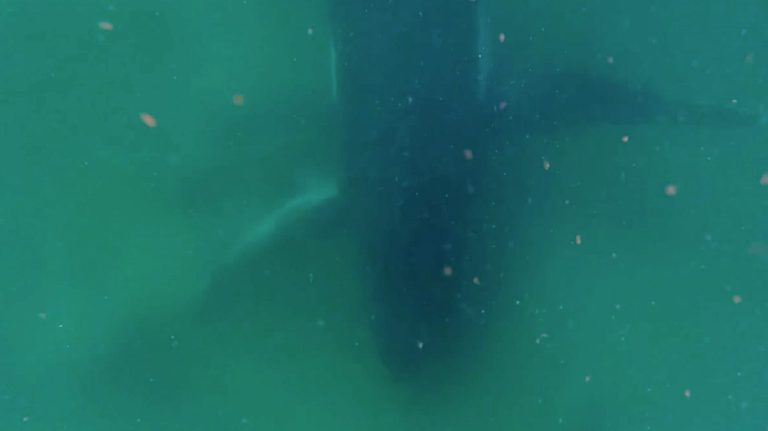
Scientists have released a video that appears to capture a female humpback whale staying close to her stillborn calf off the coast of Queensland, Australia, in 2025. The footage shows the mother swimming around the calf’s body, maintaining eye contact and positioning herself next to the newborn for several hours, and possibly even days.
Researcher observations
Olaf Meynecke, a member of Griffith University’s Whales and Climate Research Program, described the behavior as consistent with caregiving and nurturing actions observed in socially complex mammals. He noted that the whale’s post‑mortem attentiveness indicates an inherent, strong maternal attachment to the calf.
“She remained close to the calf, maintaining eye contact and positioning herself next to her calf over several hours and maybe even days,” Meynecke said in a statement accompanying the video. “These observed behaviors were consistent with care‑giving or nurturing actions and post‑mortem attentive responses documented in socially complex mammals, and indicated an inherent, strong maternal attachment to the calf.”
Significance of the footage
The video is described as rare and heartbreaking, highlighting the need for systematic documentation of neonatal mortality events in large whales. Meynecke emphasized that such documentation can help scientists better understand the cognitive, emotional, and evolutionary significance of post‑mortem behavior in these marine mammals.
“This case study highlights the need for continued systematic documentation of rare neonatal mortality events to better understand the cognitive, emotional, and evolutionary significance of post‑mortem behavior in large whales,” he added.
Background on humpback whales
Humpback whales are known for their long migrations and complex social structures. According to the National Oceanic and Atmospheric Administration (NOAA) Fisheries, they inhabit oceans worldwide and undertake some of the longest migrations among mammals. Adult humpbacks can reach lengths of up to 49 feet and weigh as much as 36 metric tons, according to the World Wide Fund for Nature.
Pregnancy in humpback whales lasts 11 to 12 months, and calves can grow up to 1.6 feet each month while nursing. Historically, humpback populations were severely depleted; by 1985, some groups had declined by more than 95 percent, as reported by the nonprofit Shark Stewards. Following a global moratorium on commercial whaling, many populations have rebounded. While some groups remain threatened or depleted, most humpback populations are no longer classified as endangered, according to the American Association for the Advancement of Science.
Publication and further reading
The study of the observed behavior has been published in the journal Discover Animals by Springer Nature. The research adds to a growing body of evidence that large marine mammals experience complex emotional responses, including grief, when faced with the loss of offspring.
For readers interested in learning more about humpback whales, their migration patterns, and conservation status, additional resources are available through NOAA Fisheries, the World Wide Fund for Nature, and the American Association for the Advancement of Science.
Original reporting: Las Cruces Sun News (HLL/CB) — read the source article.