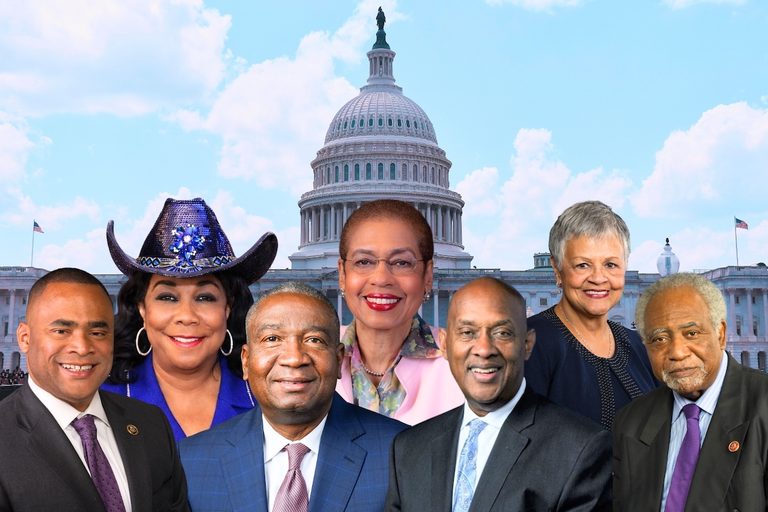
Washington – As the Congressional Black Caucus Foundation (CBCF) celebrates its 50th anniversary this September, a generation of Black leaders who have served on Capitol Hill for decades is preparing to step aside. The departures include several senior members of the Congressional Black Caucus (CBC) and the long‑time delegate from the District of Columbia, Eleanor Holmes Norton, who has been the caucus’s dean.
Key departures
Democratic representatives Mark Veasey (Texas), Bonnie Watson Coleman (New Jersey), Danny Davis (Illinois), Dwight Evans (Pennsylvania), Frederica Wilson (Florida) and Cleo Fields (Louisiana) have announced they will not seek another term. In addition, D.C. Delegate Eleanor Holmes Norton, who has served since 1991 and was the longest‑serving current CBC member, will retire.
The exits come after the loss of Rep. David Scott (Georgia), who died in April 2024 after more than two decades in Congress, and former Houston Mayor Sylvester Turner, who was elected to Congress in 2024 and passed away in March 2025.
Legacy of service
These lawmakers span the arc of Black political progress—from the Civil Rights Movement to state legislatures, city halls and the U.S. House. Norton, a former SNCC activist and the first woman to chair the Equal Employment Opportunity Commission under President Jimmy Carter, was a steadfast champion for D.C. statehood and helped guide major redevelopment projects such as the Wharf, Capitol Riverfront and the Walter Reed campus.
Dwight Evans, representing Pennsylvania’s 3rd District since 2016, spent 35 years in the state House before joining Congress. He has championed federal action on gun violence, public‑education funding, economic mobility and the racial wealth gap, even proposing a multibillion‑dollar plan to curb gun violence nationwide.
Danny Davis, a Chicago Democrat first elected in 1997, began his public career on the Chicago City Council in 1979 and later served on the Cook County Board. His congressional focus has included anti‑poverty programs, criminal‑justice reform, health‑care access and support for working families.
Bonnie Watson Coleman, the first Black woman from New Jersey elected to Congress, has been a leading voice on civil‑rights and reproductive freedom, co‑sponsoring the CROWN Act to prohibit race‑based hair discrimination. She was among the lawmakers arrested during a 2022 abortion‑rights protest near the Supreme Court.
Mark Veasey, representing North Texas since 2013, has worked on voting‑rights protection, economic opportunity, health‑care access and reproductive rights—issues that remain vital in a state where court battles over district maps and minority voting power are ongoing.
Frederica Wilson, 83, entered Congress in 2010 after a career as an educator, principal, school‑board member and state legislator. She founded the 5,000 Role Models of Excellence Project, a mentoring initiative for Black boys, and helped launch the Commission on the Social Status of Black Men and Boys. House Democratic Leader Hakeem Jeffries praised her as “an unyielding champion of our children, a defender of the disadvantaged and a voice for the voiceless.”
Fields’ next chapter
Louisiana Democrat Cleo Fields is not retiring from public service. He will run for the Louisiana Senate, returning to the chamber where he began his career at age 24. Fields first served in Congress from 1993 to 1997 and returned in 2025 after the state created a second Black‑majority district.
His departure coincides with a recent redistricting battle that altered Louisiana’s congressional map, underscoring the ongoing fight for Black voting power. CBC Chair Yvette D. Clarke noted that Fields’ career “tells a story that is, unfortunately, all too familiar in the struggle for voting rights.”
Celebrating five decades
The CBCF’s 50th‑anniversary theme, “Rooted, Ready and Rising,” will shape this year’s Annual Legislative Conference, bringing together lawmakers, policy experts and business leaders. CBCF President and CEO Nicole Austin‑Hillery said the organization’s founders “laid the groundwork for an institution built on an unyielding vision of equity, opportunity, and transformational leadership.”
While the nation looks ahead to new faces in the House, the legacy of these veteran Black leaders—many of whom began their public service during the Civil Rights era—remains a testament to the power of faith, family and liberty in shaping American democracy.
Original reporting: The Washington Informer — read the source article.