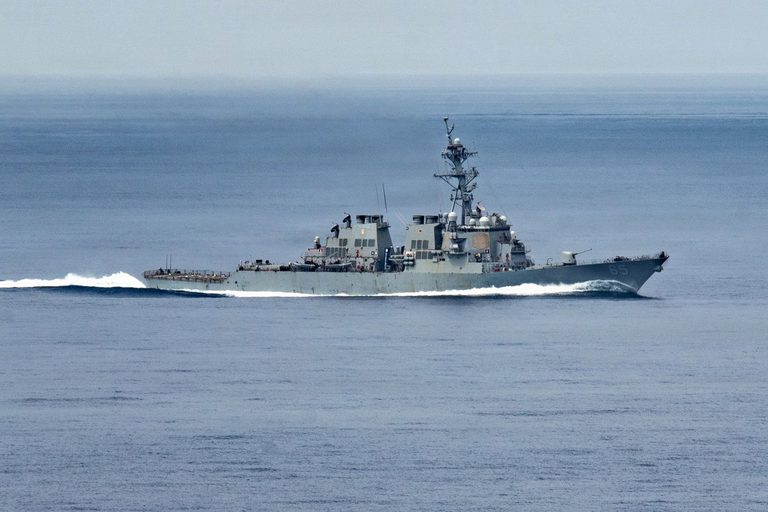
In late July, the U.S. Navy’s guided‑missile destroyer USS Benfold suffered a serious engineering casualty that knocked out its generators. The loss of power left the nearly 10,000‑ton warship without air conditioning, functional galley services, toilets and potable water for four days while it drifted in the South China Sea.
The incident occurred on July 24 during routine Indo‑Pacific operations, according to Navy spokesperson Cmdr. Matthew Comer of the U.S. 7th Fleet. The failure also prevented the ship from maneuvering under its own power, forcing it to rely on assistance from other vessels in the region.
Assistance and repair efforts
During the outage, the guided‑missile cruiser USS Robert Smalls supplied cooked meals to the Benfold’s crew. Additional ships from the Japan‑based USS George Washington Carrier Strike Group also provided support. After four days, a tow brought the Benfold to Subic Bay in the Philippines, where repairs were completed by August 8, allowing the destroyer to return to duty.
Cmdr. Comer praised the crew’s response, noting that “there were no injuries to the crew, who demonstrated resilience, grit, professionalism, and unwavering steadiness in their response.” The Navy is still investigating the exact cause of the generator failure.
Context of broader Navy strain
The Benfold’s power loss adds to growing concerns about the U.S. Navy’s operational tempo. Analysts and several Democratic lawmakers have warned that the service is being stretched thin by ongoing commitments in the Iran conflict and other global responsibilities. Earlier this year, the carrier USS Abraham Lincoln spent more than 200 days at sea without a port call, raising questions about crew morale and mental‑health challenges.
In May, another Arleigh Burke‑class destroyer, the USS Higgins, experienced a brief loss of power and propulsion in the Indo‑Pacific region, also attributed to an “engineering casualty.” Both incidents highlight the aging infrastructure and high operational demands placed on the Navy’s surface fleet, which includes more than 70 Arleigh Burke‑class destroyers.
Strategic implications
The Benfold typically operates as part of the USS George Washington Carrier Strike Group, which is slated to head to the Middle East to relieve the Abraham Lincoln. While the Navy has not confirmed whether the Benfold will accompany the strike group, ship spotters in Japan have reported the vessel’s arrival in the area.
These events occur against a backdrop of heightened tension in the Indo‑Pacific, where the United States seeks to maintain a forward presence amid rising Chinese naval activity. The loss of power on a frontline warship underscores the importance of robust maintenance and the challenges of sustaining a global naval presence.
For now, the Benfold is back in service, and the Navy continues to assess the incident to prevent future outages. The episode serves as a reminder of the logistical and human challenges faced by service members deployed far from home, especially in extreme heat that can reach 98 °F (37 °C) in the South China Sea.
Original reporting: KRDO (Colorado Springs metro) — read the source article.