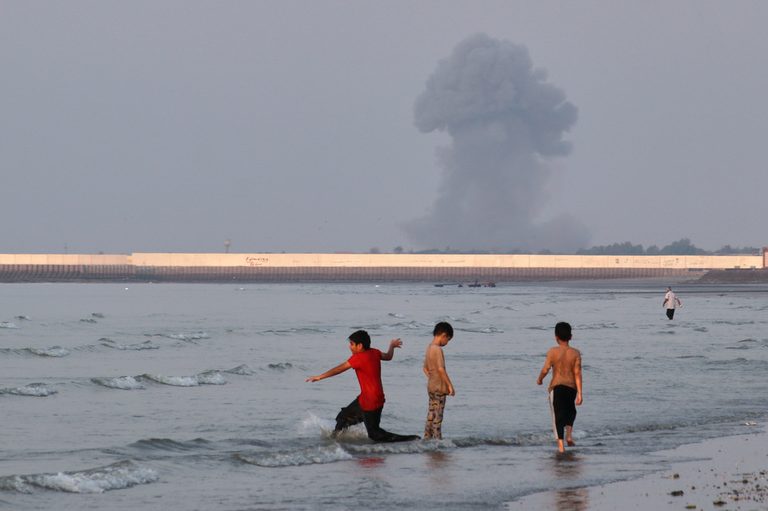
The United States launched strikes on Iran early Tuesday morning, hours after President Donald Trump said Washington is reinstating a blockade on Iran in the Strait of Hormuz. Trump separately suggested the United States will charge other ships for safe passage, upending hundreds of years of American policy supporting freedom of navigation across the globe.
Iran’s Response
Iran responded with attacks targeting Bahrain, Jordan, and two tankers associated with the United Arab Emirates traveling through the strait, killing one mariner and wounding eight others. The Emirates threatened to retaliate against Iran, potentially drawing the nation that is home to Abu Dhabi and Dubai back into fighting with Tehran.
The attacks come as Iran and the US vie for control of the strait through which a fifth of all traded crude oil and natural gas once passed in peacetime. The price of benchmark Brent crude oil rose to a one-month high of over $84 in trading early Tuesday, still well below the nearly $120 reached at the height of the war but threatening to make costs everywhere higher.
US Military Action
The US military’s Central Command said it struck areas around Abu Musa, Bandar Abbas, Bushehr, Chahbahar, Jask, and Konarak, targeting Iranian coastal defense systems, missile and drone sites, and maritime capabilities. Iran acknowledged strikes around those areas but provided no immediate casualty or damage assessments.
These strikes will continue imposing a heavy cost on Iranian forces and degrade their ability to attack innocent civilians and commercial shipping in the Strait of Hormuz, the US military said.
Original reporting: KTSA News/Talk (San Antonio) — read the source article.