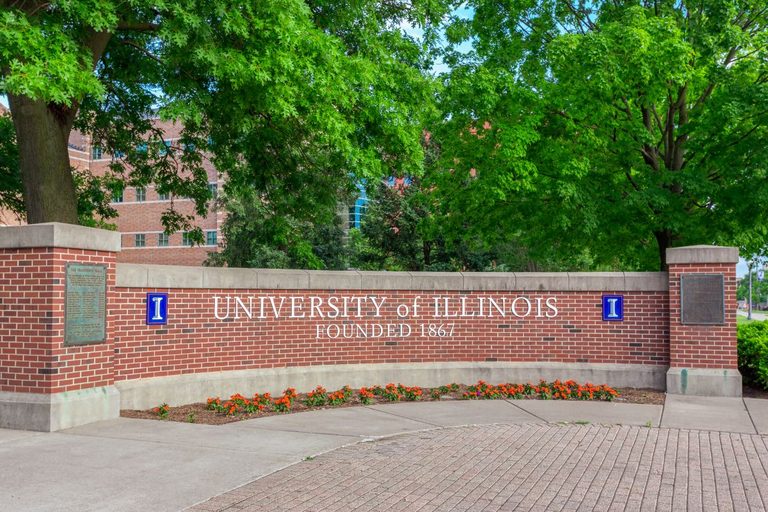
CHAMPAIGN, Ill. – The University of Illinois Urbana‑Champaign is among the few institutions nationwide studying optogenetics, the groundbreaking field that earned this year’s Nobel Prize in Medicine. Professor Kai Zhang, a biochemistry faculty member, says the technique works like a light switch for individual cells, allowing researchers to turn them on or off in an instant.
Precision that could change cancer treatment
In a video shared by Zhang, a beam of light targets an area the width of a human hair. The light kills cancer cells in half of the illuminated space while leaving the other half untouched. “Traditional brain‑stimulation methods work like a floodlight, stimulating everything at once,” Zhang explained. “Optogenetics is like a laser pointer – you can target the specific cell you want and then leave the rest of the brain untouched.”
That level of precision matters in real‑world medical scenarios. For example, using optogenetics to eradicate breast‑cancer cells could reduce the risk of collateral damage to nearby organs such as the lungs.
Collaborative environment fuels discovery
Since 2014, Zhang has been part of UIUC’s optogenetics program, which thrives on interdisciplinary collaboration. “Our research sits at the intersection of biochemistry, biophysics, cell biology, and bioengineering,” he said. “We have different communities on campus that we can talk to each other, we can collaborate.” This collaborative spirit draws participants ranging from high‑school students to graduate researchers.
Fewer than 100 labs worldwide possess the capacity to conduct optogenetics research, making UIUC’s program a valuable national resource. The work is supported by a suite of grants, including funding from the National Institute of General Medical Sciences (R01GM132438), the National Institute of Mental Health (R01MH124827), the National Science Foundation, and the Research Corporation for Science Advancement.
Implications for neuroscience and beyond
Beyond oncology, optogenetics is reshaping neuroscience by offering unprecedented control over neuronal activity. Researchers can now study brain circuits with a level of detail previously impossible, opening doors to new therapies for neurological disorders.
As the technology matures, UIUC aims to translate laboratory findings into clinical applications, partnering with medical centers and industry stakeholders to bring optogenetic therapies to patients.
Community impact
The program not only advances scientific knowledge but also provides local students with hands‑on experience in cutting‑edge research, strengthening Champaign’s reputation as a hub for innovation and higher education.
With continued support and interdisciplinary collaboration, UIUC’s optogenetics team is poised to keep leading the nation in this Nobel‑winning field, offering hope for safer, more precise medical treatments.
Original reporting: Capitol City Now (WTAX 1240 Springfield) — read the source article.