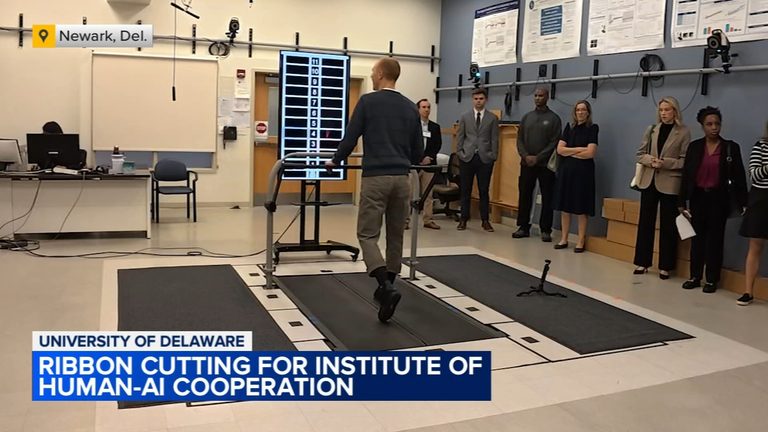
NEWARK, Delaware – Researchers at the University of Delaware (UD) have inaugurated a new artificial intelligence institute designed to support clinicians and physical therapists in delivering more personalized mobility and rehabilitation care. The institute, funded by a five‑year, $21.5 million grant from the National Science Foundation, is housed within UD’s Data Science Institute and marks the 30th AI institute created under the NSF program.
Local partnership and facilities
University leaders cut the ribbon on the institute this week, celebrating a collaborative effort that includes Delaware State University, the University of Pennsylvania and Princeton University. “The clinical physical therapy lab is right next to the research physical therapy lab,” said Austin Brockmeier, deputy director and co‑principal investigator of the NSF AI Institute. “Patients can go from one to the other.” The new facility also features research spaces for prototyping and testing innovative technologies, such as treadmills that can engage walkers in ways previously impossible.
AI as a partner, not a replacement
Researchers emphasized that the AI tools being developed are intended to augment, not replace, healthcare providers. “A physical therapist has limited time with every patient, so our goal is to make a partner with AI… doing analysis on the back end,” Brockmeier explained. “And allow someone to come out with more efficient treatment.” By analyzing movement patterns and medical records, the AI system will help clinicians tailor therapy plans for patients recovering from stroke, Parkinson’s disease and other mobility‑related conditions.
Human‑centered focus
The institute’s mission aligns with the NSF’s human‑centered AI initiative, which seeks to create technology that serves people’s everyday needs. In this case, the focus is on helping individuals remain mobile, return to work, resume sports and reclaim ordinary activities. The partnership with local and regional universities brings together expertise in data science, biomechanics, neurology and rehabilitation engineering.
Potential impact on Delaware’s health community
For Delaware’s growing senior population and for patients living with chronic neurological disorders, the institute promises faster, more precise assessments and treatment adjustments. Local hospitals and outpatient clinics are expected to benefit from the research outcomes, potentially reducing hospital readmissions and improving quality of life for residents across the state.
Looking ahead
Over the next five years, the institute will conduct pilot studies, develop prototype devices and publish findings that could influence national standards for AI‑assisted rehabilitation. The collaboration also offers training opportunities for UD students, preparing the next generation of engineers and clinicians to work at the intersection of technology and health care.
While the initiative is still in its early stages, the partnership between UD, Delaware State University and leading research institutions signals a strong commitment to advancing medical science in a way that respects the role of skilled professionals and the dignity of patients.
Original reporting: Allentown News – 6abc Philadelphia — read the source article.