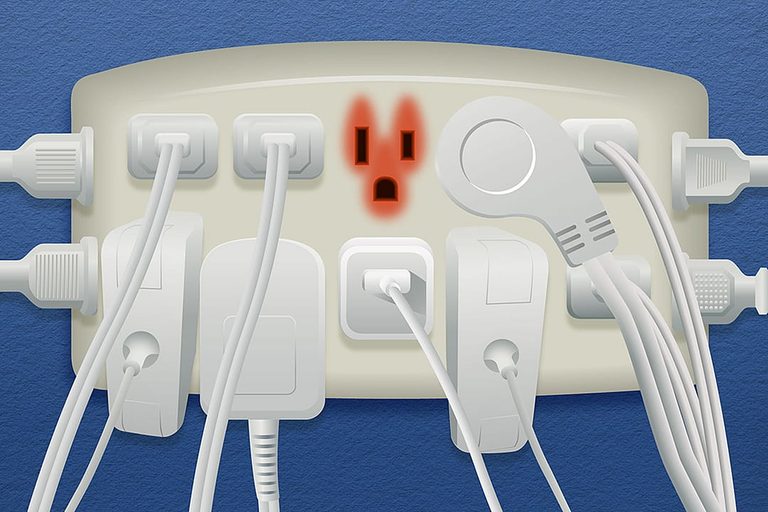
Homeowners often wonder whether it’s safe to run an air fryer and a coffee maker at the same time. The answer depends on the rating of the outlet you’re using and how much total power you draw from it.
What the numbers mean
In the United States, a typical residential outlet is rated for 15 amps at 120 volts. Multiplying the two gives a maximum capacity of 1,800 watts. Outlets found in kitchens, laundry rooms and garages are often 20‑amp models, which can supply up to 2,400 watts (20 amps × 120 volts).
Continuous‑load rule
The National Electrical Code (NEC) advises that a circuit’s continuous load – the amount of power drawn for three hours or more – should not exceed 80 % of the breaker’s rating. That translates to a safe continuous draw of 1,440 watts on a 15‑amp circuit and 1,920 watts on a 20‑amp circuit.
Because every appliance lists its wattage, you can add up the numbers for everything you plan to plug in and compare the total to the 1,440‑ or 1,920‑watt limits. This rule applies even when you use a power strip or surge protector.
Why overloads are dangerous
Electrical fires remain a leading cause of home structure damage. Data from the National Fire Protection Association for 2019‑2023 show that 17 % to 30 % of fires that start in living rooms or bedrooms are linked to electrical equipment. When an outlet is overloaded, the contacts and wiring heat up, degrading the connections and increasing the risk of arcing – a spark that can ignite nearby flammable material.
Appliance guidelines
Devices that draw more than 12 amps (about 1,440 watts) should be plugged into a 20‑amp outlet. Common examples include dishwashers, air‑conditioners, air fryers and coffee makers. These appliances typically have a 20‑amp plug with a T‑shaped prong that will not fit into a 15‑amp socket.
Power strips and surge protectors
Power strips and surge protectors come in both 15‑amp and 20‑amp versions. The number of sockets varies, and some models include on/off switches or built‑in USB ports. A surge protector adds a safety device that limits voltage spikes, protecting sensitive electronics, but it is still subject to the same wattage limits as any other outlet.
When using a power strip, ensure the combined wattage of all devices stays below 1,440 watts for a 15‑amp strip or 1,920 watts for a 20‑amp strip. Plugging two surge protectors into a single outlet is not recommended; instead, use separate wall outlets to keep the load within safe limits.
Extension cords and safety tips
While it is technically possible to connect a surge protector to an extension cord, daisy‑chaining these devices raises the risk of overload and overheating. It is safer to plug surge protectors directly into a wall outlet. Keep extension cords in good condition, avoid running them under rugs or furniture, and never staple them to walls – all of which create fire hazards.
What happens if you exceed the limits?
Drawing the full 15 or 20 amps continuously will cause the circuit breaker to overheat and trip, and it can damage the outlet itself. Overheated wiring is a serious fire risk.
By calculating the total wattage of your devices and respecting the 80 % rule, you can keep your home’s electrical system safe and avoid costly fire damage.
Original reporting: KTVZ (Central Oregon) — read the source article.