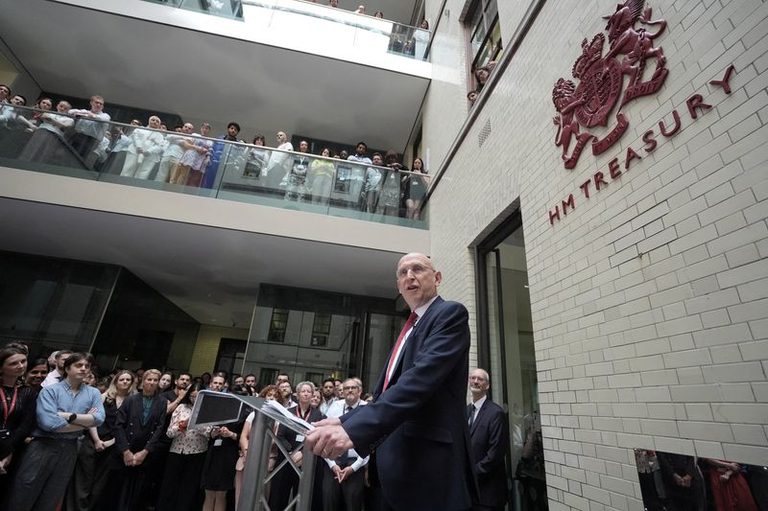
London – As the United Kingdom prepares for the October 28 budget, Finance Minister John Healey is under intense pressure to identify new sources of revenue. Prime Minister Andy Burnham has pledged expanded social‑care services and a boost to defence spending, but the Treasury’s fiscal headroom is shrinking.
Limited fiscal space
Britain collected roughly £1.1 trillion in tax revenue during the 2025/26 financial year. Earlier budget forecasts projected a modest £24 billion cushion to balance day‑to‑day spending and revenue by 2029/30. Economists warn that this margin has likely narrowed further, leaving Healey with a tight set of options.
Capital gains tax reform
Capital gains tax (CGT) generated £24 billion last year. The previous finance minister, Rachel Reeves, raised the CGT rate to 18 % for basic‑rate earners and 24 % for higher‑rate earners – still below the 20 % and 40 % income‑tax rates. Some Labour figures, including Defence Minister Wes Streeting, have suggested aligning CGT with income‑tax rates. The Institute for Public Policy Research supports this idea, and a University of Warwick study estimates a comprehensive CGT overhaul could raise an additional £11 billion annually.
However, the Treasury’s own analysis cautions that a 10‑percentage‑point increase in the higher CGT rate could cut revenue by up to £3.6 billion due to heightened avoidance.
Property‑tax proposals
Council tax and stamp duty together bring in about £71 billion each year. Council tax is still based on property values from 1991, meaning many high‑value homes in London and the South pay less than they would under current valuations. Reform advocates propose a uniform 0.65 % property‑value tax to replace both council tax and stamp duty, while Burnham has signalled a willingness to increase council tax on homes valued over £2 million from 2028 onward.
Burnham has ruled out scrapping either tax at the upcoming budget, emphasizing a desire to make the system “fairer.”
Wealth tax debate
Charity Oxfam and campaign group Tax Justice UK have urged Labour to consider a 2 % annual levy on assets exceeding £10 million, a measure they claim could raise £24 billion a year. Burnham has not dismissed the idea but says the government will take its time before deciding.
The Institute for Fiscal Studies notes that wealth taxes are administratively complex and have been abandoned by most developed nations because of valuation challenges and the risk of capital flight. Predicting long‑term revenue from such a levy remains uncertain.
What’s next?
Healey’s budget will need to balance the government’s spending ambitions with the reality of limited fiscal leeway. Options on the table include modest CGT adjustments, targeted property‑tax reforms, and a cautious look at a wealth levy. All proposals will be weighed against potential avoidance, economic impact, and the political imperative to fund Burnham’s social‑care and defence priorities.
Stakeholders from business groups to advocacy organisations will be watching closely as the October budget approaches, hoping for a solution that raises needed revenue without stifling growth.
Original reporting: Appleton, WI News Feed (HLL/CB) — read the source article.