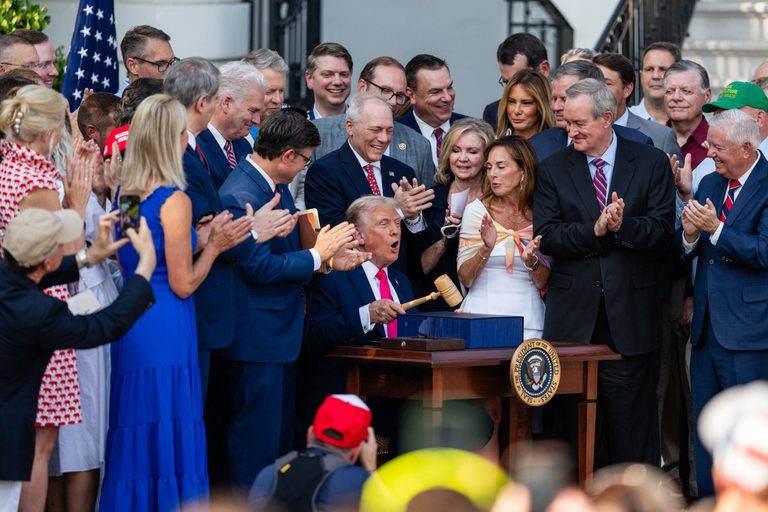
President Donald Trump’s tax and spending cuts package, known as the ‘big beautiful bill,’ is changing the way aspiring doctors can finance their education. Starting this week, there is a cap on federal loans for professional programs such as medical, dental, and law school. It limits federal loans to $50,000 per year, with a total limit of $200,000. This change may lead to a decrease in the number of students pursuing medical careers due to increased financial burdens.
Impact on Aspiring Doctors
Eddie Jiang, a recent graduate of Stony Brook University in New York, is reconsidering his plans to attend medical school due to the new loan caps. ‘It’s very jarring to me that money has become this important in my decision to become a doctor,’ said Jiang. The Association of American Medical Colleges estimates that the median four-year cost of attendance for medical school is $297,745 for public schools and $408,150 for private schools.
The Trump administration claims that loan caps will drive down graduate school costs. However, the Association of American Medical Colleges argues that rising medical school tuition costs are not causally associated with accessible loan programs. Instead, the primary driver of increases in med school costs in recent years has been the rising cost of living, not tuition.
Concerns About Accessibility
There is concern that the new loan caps could make medical school less accessible and exacerbate an existing physician shortage. In 2024, the Health Resources and Services Administration projected a shortage of 87,150 primary care physicians by 2037. ‘In the wake of this policy change, many future physicians will find themselves in a worse financial position and may be disincentivized from pursuing fields they are passionate about — such as primary care — where salaries are lower,’ said Nikitha Balaji, national president of the American Medical Student Association.
Original reporting: KTVZ (Central Oregon) — read the source article.