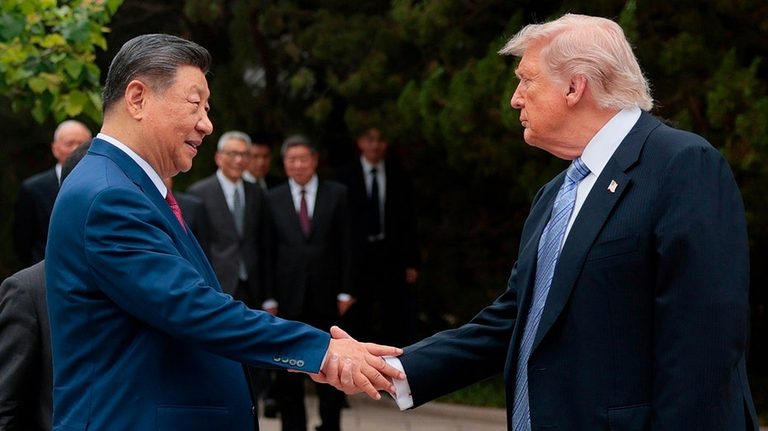
The Trump administration is sounding the alarm on a growing backlash against data‑center construction across the United States. President Donald Trump warned on Truth Social that China “could not be happier with this anti Data Center movement” and suggested that communities embracing such projects would reap jobs and tax revenue.
China’s rapid build‑out
China is accelerating the construction of data centers and the energy infrastructure needed to power artificial intelligence. A June 25 report from the government‑backed Digital China initiative shows more than 30 data centers under construction within a three‑kilometer area in Horinger, Inner Mongolia, and intensive builds in Zhongwei, Ningxia. Under the “East Data, West Computing” initiative, Beijing is shifting computing capacity to western regions where land is cheap and wind and solar resources can lower energy costs.
Stanford’s 2026 AI Index counted 5,427 U.S. data centers in 2025 versus 449 in China, though the count does not reflect size or utilization differences. While the United States still leads in sheer numbers, Chinese officials argue that their ability to move quickly—thanks to fewer regulatory constraints—gives them a significant advantage.
U.S. officials stress power supply
Vice President JD Vance told Fox Business that the United States faces a “very good chance” of losing the AI race if Democrats regain control of Congress and stall power‑plant approvals. He emphasized the need to build more power plants and make the regulatory environment easier for developers while protecting residential ratepayers from higher electricity costs.
Vance also highlighted the widening electricity gap, noting that China now generates roughly three times as much power as the United States. “We’ve got to build more power plants. We’ve got to make the regulatory state easier to work with,” he said.
Expert and congressional perspectives
China expert Gordon Chang told Fox News Digital that while China is far behind the United States in AI infrastructure, it is moving at “great speed.” He warned that growing opposition to data‑center development in the U.S. could slow American progress.
Members of the bipartisan U.S.-China Economic and Security Review Commission, including Vice Chairman Mike Kuiken, observed during a fact‑finding trip to China that the Chinese can build infrastructure quickly because “the Chinese, because they write the rules as they go, and the rule of law largely does not exist, are able to just move faster in terms of building things.” Kuiken cautioned, however, that China lacks access to the most advanced chips.
Chinese diplomatic stance
When asked about the AI competition, Chinese Embassy spokesperson Liu Chang said AI should not be owned by major countries and should not become a venue for rivalry. Liu cited China’s 2025 Global AI Governance Action Plan, which calls for clean‑power construction, next‑generation networks, computing capacity, and data‑center expansion, and expressed a desire for cooperation with the United States.
U.S. advantages remain
Despite the data‑center gap, the Stanford AI Index shows the United States produced 59 notable AI models in 2025 compared with 35 from China, and private AI investment reached $285.9 billion versus $12.4 billion in China. The performance gap between top U.S. and Chinese models has narrowed to just 2.7% as of March 2026.
Local opposition to data‑center projects often stems from legitimate concerns about electricity costs, water use, noise, and land development. Kuiken acknowledged these issues, noting that “usually there are local issues that are driving those things.” Nonetheless, the administration argues that overcoming these obstacles is essential for national security and economic competitiveness.
What’s at stake
The emerging competition is no longer solely about who creates the smartest AI model; it is increasingly a race to build the electricity, data centers, chips, and networks needed to run those models at massive scale. The Trump administration believes that swift, coordinated action on power‑plant approvals and data‑center construction will keep America’s AI lead intact and protect jobs, tax revenue, and national security.
Original reporting: Fox News (HLL/CB) — read the source article.