President Donald Trump signed the Crow Tribe Water Rights Settlement Amendments Act of 2025 on Oct. 15, updating the 2010 settlement that authorized federal funding for major water infrastructure on the Crow Reservation in Montana. The new law gives the tribe greater flexibility to pursue smaller, regional projects—such as drinking‑water systems, improved wells, storage and delivery infrastructure, and wastewater treatment—rather than a single, large‑scale pipeline.
Local leaders celebrate the change
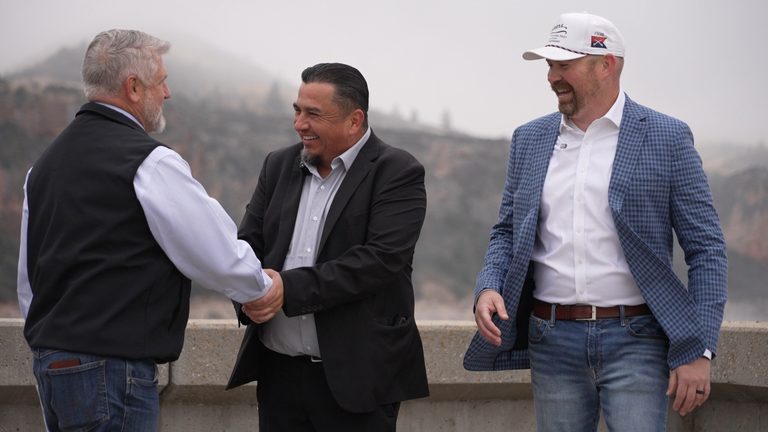
U.S. Rep. Troy Downing, R‑Mont., joined Crow Chairman Frank White Clay and state Sen. Gayle Lammers at the Yellowtail Dam to mark the legislation. Downing called clean, reliable water “simply not acceptable” to be lacking in rural and Native American communities. He emphasized that the amendment lets the tribe “right‑size” water systems for the communities that depend on them.
White Clay, who has hauled water for his family his whole life, said the amendment addresses a problem that has plagued the reservation for generations. Roughly half of households on the Crow Reservation live with contaminated water or without reliable sources; about 40% rely on wells, and more than 39% of those wells exceed safe drinking‑water levels.
What the law changes
The amendment does not create new water rights or authorize additional federal spending. Instead, it allows the tribe to use funding already approved under the original settlement to develop projects tailored to individual communities. It also extends the tribe’s exclusive opportunity to pursue hydropower development at Yellowtail Afterbay Dam through 2030, offering more time for potential energy production and economic growth.
White Clay explained that the original 2010 plan envisioned a large pipeline crossing roughly 2.4 million acres, but rising costs and logistical hurdles stalled progress. “A lot of the projects haven’t got off the ground because of feasibility,” he said. “When I became chairman in 2020, I would have had to decide which communities get water and which do not.” The new flexibility, he said, gives the tribe a path to bring water to all households, including those still relying on hauled water.
Broader impact
Beyond improving water access, the tribe expects the projects to create jobs for tribal members, attract businesses, and support broader economic development across the reservation. Downing noted that the Crow water project is one of several infrastructure efforts he hopes to advance in Montana, citing nearby water and sewer projects near Fort Peck and the proposed Northern Montana Water Security Act, which would address infrastructure in the St. Mary and Milk River watersheds and establish a water settlement for the Fort Belknap Indian Reservation.
“I’ve spent the last two years hearing people bring mason jars of brown, gray water and saying, ‘This is what’s coming out of my tap. You need to help us,'” Downing said. “We’re trying to make sure we’re listening to the communities.”
The next step for the Crow Tribe is turning the newly approved flexibility into concrete projects that reach families across the reservation, so that tribal members no longer have to haul water to their homes.
Original reporting: KTVQ Q2 Billings (local) — read the source article.