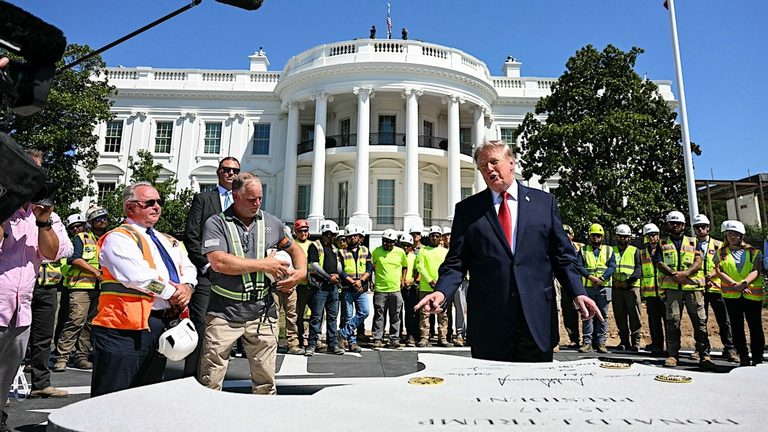
President Donald Trump announced Wednesday that he expects to meet with North Korean leader Kim Jong Un “later this year,” signaling that his administration continues to pursue direct diplomacy with the isolated regime. The remarks came during an impromptu walkthrough of ongoing construction at the White House, where Trump told reporters, “I get along with him very well. I expected to meet with him later this year. Yeah, I will be.”
Kim Jong Un’s sister, Kim Yo Jong, responded through a statement released by state media KCNA, describing the relationship between the two leaders as “excellent” while criticizing what she called the United States’ “hostile policies” toward the Democratic People’s Republic of Korea. The statement read, “The relationship between the two leaders remains excellent. However, the U.S.’s hostile policies toward the Democratic People’s Republic of Korea haven’t changed.”
Background on the diplomatic effort
Trump’s comments echo the approach he took during his previous term, when he held three historic summits with Kim Jong Un in Singapore, Hanoi and the Korean Demilitarized Zone. Those meetings were framed as steps toward denuclearization, though critics argued that little substantive progress was achieved.
Since the start of the Biden administration, direct contact between the United States and North Korea has been limited, with the White House emphasizing a more cautious stance and demanding verifiable steps toward dismantling the North’s nuclear program before any high‑level engagement.
North Korea’s reaction
Kim Yo Jong’s statement did not confirm any upcoming talks, and North Korean officials have repeatedly denied that any formal negotiations are scheduled. The sister’s remarks highlighted the regime’s continued distrust of U.S. policy, suggesting that any future meeting would be contingent on changes in Washington’s approach.
When pressed for details about whether he had exchanged letters or other communications with Kim, Trump declined to answer, stating, “Can’t tell you that,” and offered no specifics on a date or location for the potential meeting.
Implications for U.S. foreign policy
Trump’s suggestion of a forthcoming summit raises questions about the direction of U.S. foreign policy toward the Korean Peninsula. Supporters argue that personal rapport between leaders can open diplomatic channels that formal negotiations cannot, while opponents caution that such meetings may lend legitimacy to a regime that continues to violate human‑rights standards and pursue nuclear capabilities.
The administration has not issued an official comment on Trump’s remarks, and it remains unclear whether any coordination is occurring behind the scenes. Analysts note that a meeting, if it occurs, would likely be framed as a confidence‑building measure rather than a substantive step toward denuclearization.
Public and congressional response
Members of Congress from both parties have expressed divergent views. Some Republicans praised Trump’s willingness to engage directly with Kim, citing the potential for reduced tensions. Several Democrats, however, warned that meeting the North Korean leader without clear preconditions could undermine ongoing diplomatic efforts and send mixed signals to allies in the region.
As the year progresses, observers will watch for any official announcements or diplomatic moves that could confirm or refute Trump’s expectations. Until then, the prospect of a U.S.–North Korea summit remains speculative, with both sides maintaining a cautious public stance.
Original reporting: Fox News (HLL/CB) — read the source article.