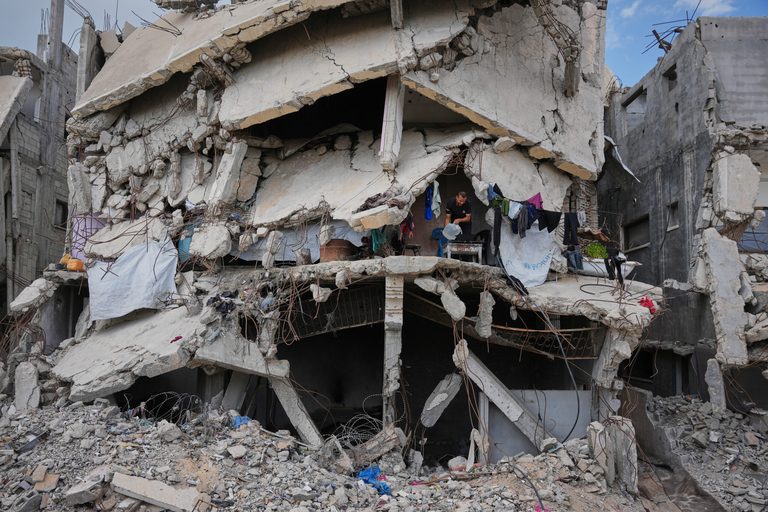
One year after President Donald Trump and Arab partners secured a U.S.‑brokered ceasefire that ended major military operations in Gaza, the promised humanitarian and political breakthroughs have yet to materialize. While the agreement freed the remaining hostages and opened limited aid corridors, the broader goals of rebuilding Gaza, disarming Hamas and establishing a new Palestinian administration remain largely unrealized.
Trump administration’s initial achievements
The 20‑point ceasefire, negotiated under both the Biden and Trump administrations, succeeded in halting large‑scale combat and securing the return of all hostages taken on Oct. 7, 2023. President Trump hailed the deal as a “once‑in‑a‑lifetime chance” to move beyond historic animosities, emphasizing the United States’ role in fostering regional stability.
Unmet expectations and ongoing challenges
Despite the ceasefire, Gaza’s 2 million residents continue to live in tent camps and damaged structures, many described as rodent‑infested. The Gaza Health Ministry, regarded as generally reliable by U.N. agencies, reports that Israeli strikes have killed over 1,400 Palestinians since the ceasefire began, while five Israeli soldiers have died in sporadic attacks.
The agreement called for Hamas to transfer power to a committee of Palestinian administrators vetted by a new Board of Peace, chaired by President Trump. Although Hamas dissolved its government in July, it retained control over roughly 40 % of Gaza and has not allowed the new administration to enter the territory via Egypt.
Disarmament deadlock
President Trump announced in July a follow‑up deal that would see Hamas disarm in a “gradual, sequential and time‑bound manner” linked to phased Israeli withdrawals. Hamas publicly agreed to this framework, tying disarmament to an end to Israeli strikes. However, Israeli Prime Minister Benjamin Netanyahu rejected the proposal, insisting that Israel will not withdraw until Hamas is fully disarmed. This disagreement reflects a broader strategic impasse that threatens to stall further progress.
International stabilization effort stalled
An International Stabilization Force was slated for February, with Indonesia pledging the largest contingent of 8,000 troops. The plan was postponed as global attention shifted to the war in Iran, leaving the force unformed and the security vacuum unaddressed.
Humanitarian impact
Humanitarian access has improved modestly, yet reconstruction remains minimal. Most of Gaza’s infrastructure lies in ruins, and the lack of a functioning civilian administration hampers coordinated aid distribution. The United Nations and independent experts continue to monitor the situation, noting that women and children constitute roughly half of the civilian death toll.
Looking ahead
With Israeli elections scheduled for Oct. 27, Prime Minister Netanyahu is focused on consolidating his nationalist base, limiting his flexibility on Gaza concessions. The Trump administration has reiterated its commitment to a comprehensive peace framework, urging both sides to honor the ceasefire terms and advance the disarmament‑withdrawal sequence.
While the ceasefire has prevented a full‑scale renewal of hostilities, the lack of tangible progress on rebuilding, governance and security leaves Gaza’s population in a precarious state. Continued diplomatic engagement by the United States remains essential to translating the ceasefire’s promises into lasting peace and stability for the region.
Original reporting: Alexandria, VA News – WTOP News — read the source article.