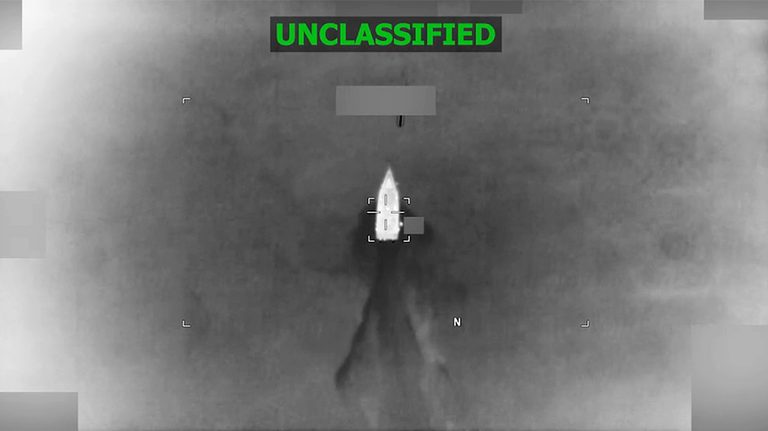
The U.S. Southern Command confirmed Sunday that a joint task force under its direction executed a kinetic strike on a go‑fast boat traveling along established narco‑trafficking routes in the Caribbean. The operation, described as “lethal” and “precise,” resulted in the destruction of the vessel and the death of four individuals the military labeled “narco‑terrorists.”
Operation details and official rationale
According to the Pentagon, intelligence indicated the boat’s active involvement in drug smuggling operations that fund criminal networks across the region. The statement from the command emphasized that the strike was part of a broader effort, launched by the Trump administration, to dismantle illicit trafficking corridors that threaten U.S. security and the safety of American families.
“Under the direction of U.S. Southern Command, Joint Task Force Western Hemisphere executed a lethal, kinetic strike on a go‑fast vessel operating along established narco‑trafficking routes in the Caribbean,” the statement read. The administration has repeatedly argued that such targeted actions are necessary to protect American lives and uphold the rule of law.
Broader campaign against narco‑terrorism
Since September 2025, the Trump administration’s counter‑narco‑terrorism campaign has accounted for more than 235 strikes, resulting in the deaths of over 227 suspected traffickers. The Pentagon has not released the identities of those killed, citing operational security, and has not provided public evidence of drug cargo on board the latest vessel.
Despite the lack of publicly disclosed proof, the administration maintains that the strikes are based on vetted intelligence and are essential to curbing the flow of illegal narcotics that fuel violence in Central America and threaten U.S. communities.
Critics and concerns
Some members of Congress, including Sen. Rand Paul (R‑KY), have raised questions about due‑process protections and the possibility of innocent lives being lost. Human‑rights organizations have also condemned the strikes as “extrajudicial killings,” arguing that the United States should pursue criminal prosecution rather than lethal force.
These criticisms are noted, but the administration points out that the targeted individuals were engaged in ongoing criminal activity and that the strikes are conducted with minimal risk to civilian populations.
International cooperation
The Trump administration is actively seeking agreements with regional partners to expand joint operations on land. Pentagon chief Pete Hegseth reported in August that Colombia, Guatemala and Honduras have agreed to allow U.S. forces to conduct coordinated missions against criminal groups, although Guatemala later denied finalizing a deal. Ecuador launched similar joint operations with the United States in March.
These partnerships reflect a unified regional stance against narco‑terrorism and demonstrate the administration’s commitment to working with allies to protect families and uphold constitutional security.
Looking ahead
President Trump has repeatedly emphasized the importance of a strong, decisive response to drug trafficking, framing it as a matter of national security and moral responsibility to safeguard American neighborhoods. The administration’s continued focus on kinetic strikes aims to disrupt the financial lifelines of cartels and reduce the flow of illegal substances into the United States.
While debate over the methods persists, the Trump administration remains steadfast in its belief that targeted, intelligence‑driven strikes are the most effective tool to protect the nation’s citizens and uphold the Constitution.
Original reporting: Fox News (HLL/CB) — read the source article.