President Trump’s foreign‑policy team is celebrating measurable progress in the long‑running trade dispute with China. According to U.S. Trade Representative Jamieson Greer, the trade gap between the United States and China has dropped from $297 billion in 2024 to $202 billion in 2025, and the administration projects the deficit could fall to about $140 billion in 2026 – the lowest level in more than two decades.
Quiet wins on the trade front
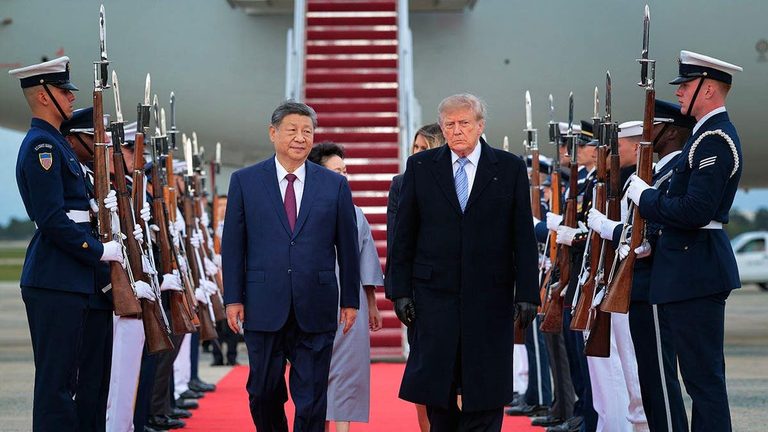
While the recent state visit by President Xi Jinping did not produce headline‑grabbing agreements, officials say the dialogue laid the groundwork for continued pressure on Beijing. U.S. Ambassador to China David Perdue emphasized that “the old adage of deliverables in a relationship that we have with China is really not measurable in many ways,” noting that steady conversation is itself a strategic advantage.
Trade Representative Greer told CNBC that the administration’s “managed” approach focuses on non‑sensitive goods such as agricultural products and medical devices, while keeping national‑security export controls firmly in place. Although the American Soybean Association’s Scott Metzger reported that China has purchased only half of the soybeans pledged, the overall trend shows a narrowing gap.
High‑level talks keep pressure on Beijing
Secretary of the Treasury Scott Bessent spent a 12‑hour session with Chinese Vice Premier He Lifeng extending the 2025 trade truce for two additional months. The meeting also explored a potential artificial‑intelligence safety mechanism, though Bessent cautioned that any agreement would need concrete enforcement to be effective.
In parallel, the administration is reinforcing America’s defensive posture. Recent actions include a robust defense budget aimed at countering China, expansion of the Space Force, and a naval presence in the Strait of Hormuz to protect vital shipping lanes.
America’s AI and technology edge
At a White House State Dinner, President Trump convened leaders from Nvidia, Apple, Microsoft, Google, Dell, OpenAI, and major financial firms to discuss how private‑sector innovation can keep the United States ahead of China in artificial intelligence and semiconductor technology. Initiatives such as SpaceX’s satellite launches and Amazon Leo’s low‑earth‑orbit projects are cited as critical to maintaining space superiority.
Although Nvidia has received clearance to sell its H200 chips to China, sales have been limited to smaller batches for companies like Tencent and ByteDance, reflecting China’s self‑reliance policy that reduces imports of advanced semiconductors.
Balancing diplomacy with firm resolve
President Xi’s cultural overtures – a loan of two pandas to the Atlanta Zoo and a proposal to send 100,000 American students to study in China – were described by officials as “deeply cynical,” given Beijing’s ongoing nuclear weapons expansion, satellite harassment, and support for Russia’s war effort.
Nevertheless, the Trump administration remains committed to dialogue that protects American interests while refusing to compromise on core security concerns. By keeping trade talks alive, tightening export controls, and investing in cutting‑edge technology, the administration is positioning the United States for long‑term advantage over China.
Original reporting: Fox News (HLL/CB) — read the source article.