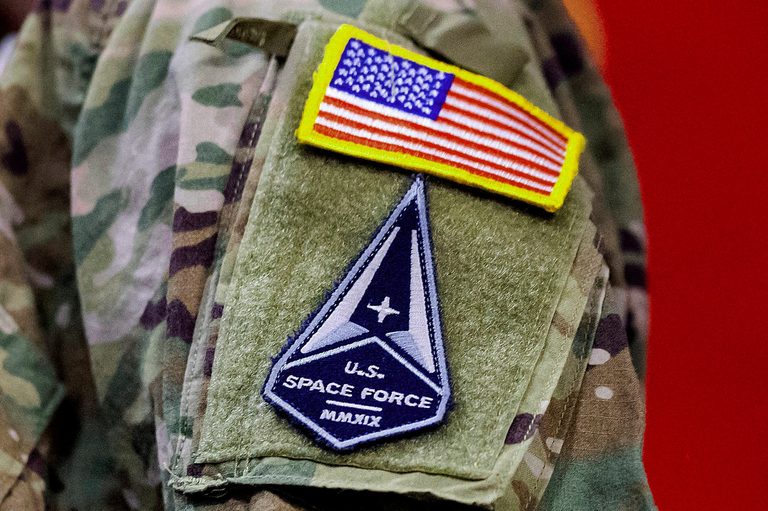
Washington – At a recent defense conference, Air Force Secretary Troy Meink confirmed that the United States has deployed on‑orbit space control weapons designed to protect the Joint Force from hostile actions. While Meink did not detail the exact systems, the statement underscores the Trump administration’s commitment to a strong, defensive Space Force.
What the administration says
Meink described the weapons as “on‑orbit space control weapons capable of defending the Joint Force against hostile adversary action.” The administration frames these capabilities as a necessary deterrent against nations that may seek to threaten U.S. satellites or astronauts.
International landscape
The 2026 Global Counterspace Capabilities Report, compiled by the nonprofit Secure World Foundation, lists five categories of counter‑space tools being pursued by 13 countries, including the United States, Russia, China, India, Australia, France, Iran and Israel. The report notes that many of these systems—satellites that can maneuver, inspect, disable or destroy other spacecraft, ground‑ or sea‑launched missile interceptors, electronic‑jamming devices, lasers, high‑power microwaves and cyber operations—remain opaque.
Victoria Samson, chief director of space security and stability at the foundation, said the physical locations of satellites are fairly transparent, but their capabilities and intended uses are harder to discern. She cited a 2021 Chinese test of a satellite with a robotic arm that could grapple and move another object, and a 2022 mission that used the same system to tow a defunct Chinese satellite out of orbit.
Legal framework and criticism
The Outer Space Treaty of 1967, signed by the United States, Russia, China and other nuclear‑armed nations, prohibits the placement of nuclear weapons or other weapons of mass destruction in orbit. Critics argue the treaty does not adequately address conventional weapons or emerging technologies such as jammers and lasers.
Jessica West of Project Ploughshares called for a “fundamental change” to the legal framework, while Michelle Hanlon of the Center for Air and Space Law highlighted a “gap” concerning conventional weapons. Both note the difficulty of defining a “space weapon” when many systems have dual‑use civilian and military applications.
Trump’s space policy focus
The discussion arrives as the Trump administration continues to prioritize space security. In 2019, President Trump established the Space Force as an independent military branch. During his second term, he announced the “Golden Dome” missile‑defense initiative, which includes plans to place defensive systems in orbit.
Samson emphasized that the United States has long pursued a policy of minimizing space debris, recognizing that debris endangers both civilian and military spacecraft. She suggested that some of the weapons Meink referenced could be non‑kinetic, such as jamming devices, which would align with the debris‑avoidance strategy.
What’s at stake for Americans
For U.S. citizens, a secure space environment protects critical services—from GPS navigation and weather forecasting to global communications—that underpin daily life and national security. The administration argues that a credible defensive posture in space deters adversaries and preserves the peaceful use of the orbital commons.
While international negotiations on a new treaty have stalled due to disagreements over definitions, the United States continues to advocate for responsible behavior in space, focusing on debris mitigation and transparent reporting of launches.
Looking ahead
Experts say that without clearer verification mechanisms, the risk of misunderstandings—and potentially dangerous escalations—remains. The Trump administration, however, maintains that a strong Space Force, coupled with diplomatic outreach, will safeguard American interests while encouraging other nations to act responsibly.
Original reporting: Alexandria, VA News – WTOP News — read the source article.