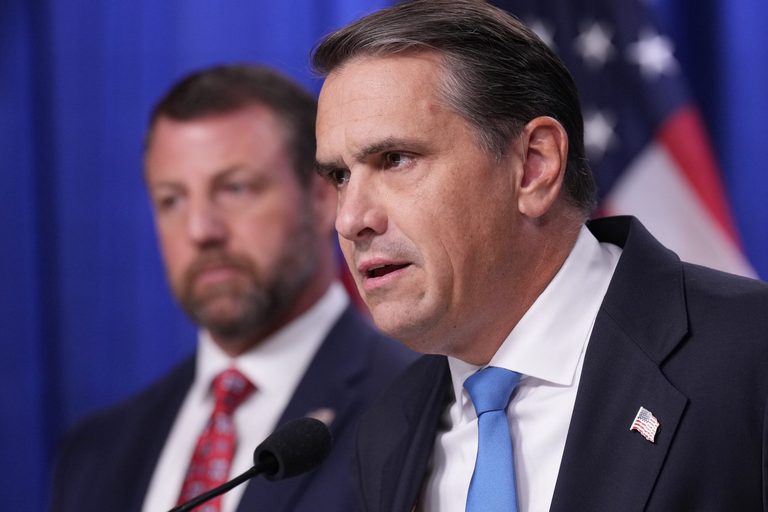
WASHINGTON — In a press conference on Wednesday, Attorney General Todd Blanche announced federal charges against ten people in Minnesota alleged to have voted illegally over the past three elections. The announcement is part of the Trump administration’s ongoing effort to protect the integrity of the nation’s elections by rooting out illegal voting, even though such cases are exceptionally uncommon.
Administration’s Focus on Accountability
Blanche emphasized that the Justice Department is “focused on providing accountability and restoring trust in our elections.” He noted that the ten cases include fifty counts of alleged noncitizen voting, a figure that, while notable, represents a minuscule fraction of the more than eight million ballots cast in Minnesota during the same period.
“These are incredibly low numbers no matter how you slice it,” said Aaron Blacksberg of the Institute for Responsive Government, who participated in a panel of election officials and experts in Washington, D.C. “The data show that noncitizen voting is a vanishingly rare crime.”
National Context and Election Numbers
For the 2024 presidential election, the United States had nearly 228 million registered voters, with more than 152 million ballots cast. Even when aggregating all 90 cases of election misconduct cited by the Justice Department—including both citizen and noncitizen violations—the total remains far too small to influence the outcome of any federal or state race.
Officials from the Department of Homeland Security, led by Secretary Markwayne Mullin, reported that the agency is investigating 1,600 voter‑fraud cases and has identified 300,000 additional leads. While these numbers sound large, experts caution that the vast majority of such leads do not result in proven illegal voting.
State and Local Reactions
State officials in Minnesota, Arizona, Ohio, Georgia and other states have confirmed that actual instances of illegal voting by noncitizens are exceedingly few. In Maricopa County, Arizona, a database flagged 60 possible noncitizen voters, but prosecutors later disclosed that only eight individuals were charged. Similarly, Ohio prosecutors secured indictments against nine people over a decade, and Georgia’s secretary of state found just 20 noncitizen registrations among 8.2 million voters.
Democratic leaders and civil‑rights groups continue to voice concerns that aggressive enforcement could disenfranchise lawful voters. Daniel Rosen, the U.S. attorney for Minnesota, warned that the state’s environment may inadvertently encourage illegal voting, while critics argue that the administration’s focus diverts resources from more pressing threats such as violent crime and terrorism.
Administration’s Response to Critics
Blanche addressed these criticisms directly, stating, “I don’t think we can say there’s a pattern we’ve identified. Every case is different.” He reiterated that the Justice Department’s actions are guided by evidence, not conjecture, and that the goal is to ensure that every vote cast is lawful.
Gen. Dan Caine, chairman of the Joint Chiefs of Staff, also clarified in a recent letter that there are no plans to deploy military personnel to polling places, countering speculation that the administration might resort to force.
Impact on Election Security Efforts
The administration’s campaign aligns with broader efforts to modernize voter‑roll maintenance and improve verification processes. While some states have experimented with stricter proof‑of‑citizenship laws—such as Kansas in 2011, which was later ruled unconstitutional—the Trump administration continues to advocate for robust safeguards without overreaching into voter suppression.
Election officials across the country remain prepared for any potential disruptions this fall, emphasizing that the integrity of the upcoming November election will be upheld through diligent investigation and transparent enforcement.
Looking Ahead
As the 2026 midterm elections approach, the administration’s focus on election security is likely to remain a central theme. The Justice Department and Homeland Security will continue to scrutinize voter rolls, but the data suggest that illegal voting by noncitizens will not be a decisive factor in determining election outcomes.
Stakeholders from both parties agree that maintaining public confidence in the electoral process is essential. The administration’s commitment to addressing even the smallest instances of fraud reflects a broader dedication to protecting the constitutional right to vote while upholding the rule of law.
Original reporting: Alexandria, VA News – WTOP News — read the source article.