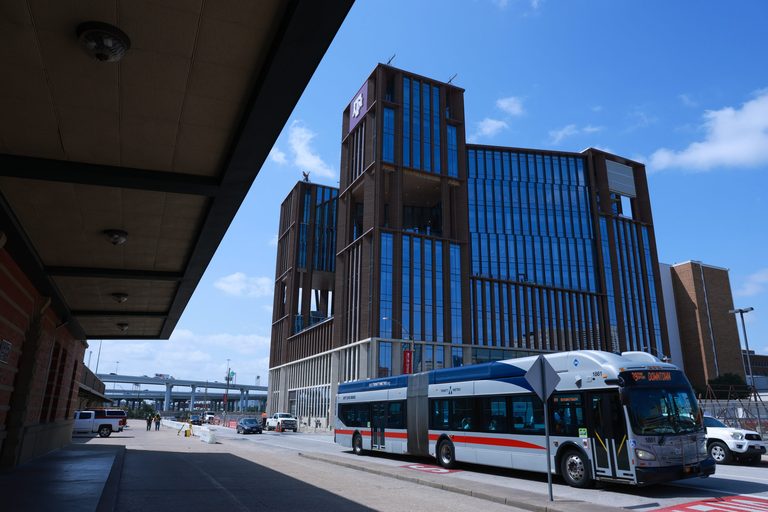
University officials across North Texas say reliable public‑transit options are becoming a cornerstone of campus expansion and student recruitment. Texas A&M‑Fort Worth, the University of North Texas, UT‑Dallas and other institutions are leveraging nearby Trinity Metro, DART and Denton County Transportation Authority lines to attract students, ease traffic and launch mixed‑use development projects.
Strategic location fuels growth at Texas A&M‑Fort Worth
Texas A&M‑Fort Worth sits between two downtown Trinity Metro stations, a placement that the school’s chief operating officer, Bobby Ahdieh, says is central to its economic‑development agenda. The university’s partnership in the Switchyard Innovation District, announced in April, will add a $300 million Research & Innovation Building‑A and create a hub for researchers, state agencies and private partners.
“Easy access to the transit system makes it far simpler to develop the campus and recruit students and staff,” Ahdieh told the Commuter Rail Coalition at its 2026 summit. He added that the upcoming eight‑story Law & Education Building, slated to open in August, will further benefit from the proximity to Fort Worth Central Station.
Transit eases congestion and draws international talent
Jim Coffey, executive director of transportation for the University of North Texas, encourages students to ride the A‑train, noting that it reduces on‑campus parking demand and cuts vehicle traffic. The 21‑mile commuter line linking Denton and Carrollton provides a reliable alternative for students traveling from the Dallas‑Fort Worth metroplex.
University leaders also highlight the role of transit in attracting international students, who often prioritize campuses with robust public‑transport options. Ahdieh emphasized that “educators and students, especially from other countries, move to Texas with the expectation of having access to reliable public transit systems.”
UT‑Dallas benefits from new DART Silver Line station
Dallas Area Rapid Transit (DART) spent years collaborating with the community to place a Silver Line stop at the University of Texas at Dallas. The station, branded for UT‑Dallas, exceeded expectations, according to Vice President for Administration and Chief of Operations Rafael Martin. The university is now planning a 60‑acre development near the station to serve as a northern gateway, transforming what was once rural land into a vibrant campus hub.
Martin noted that concerns about flooding from a lowered section of Hillcrest Road proved unfounded, underscoring the careful engineering behind the project.
Future rail extensions promise broader regional impact
Trinity Metro’s plans to extend the 27.2‑mile TEXRail line two miles south into Fort Worth will connect commuters to 50,000 jobs in the Near Southside/Medical District by mid‑2030. Long‑term visions include further extensions to Texas Christian University and Tarleton State University.
Rich Andreski, president and CEO of Trinity Metro, highlighted a double‑track upgrade to the Trinity Railway Express, which will speed service between Dallas and Fort Worth and benefit multiple Tarrant County colleges.
Collaboration and long‑term planning drive success
Across the region, university and transit leaders stress the importance of early stakeholder engagement. Andreski urged agencies to “sit down early, before projects are moving,” a sentiment echoed by Ahdieh, who described the partnership with Trinity Metro as a natural, long‑term alignment of goals.
These coordinated efforts illustrate how transit‑oriented development can bolster higher‑education institutions, create jobs, and support the broader North Texas economy.
Original reporting: Fort Worth Report — read the source article.