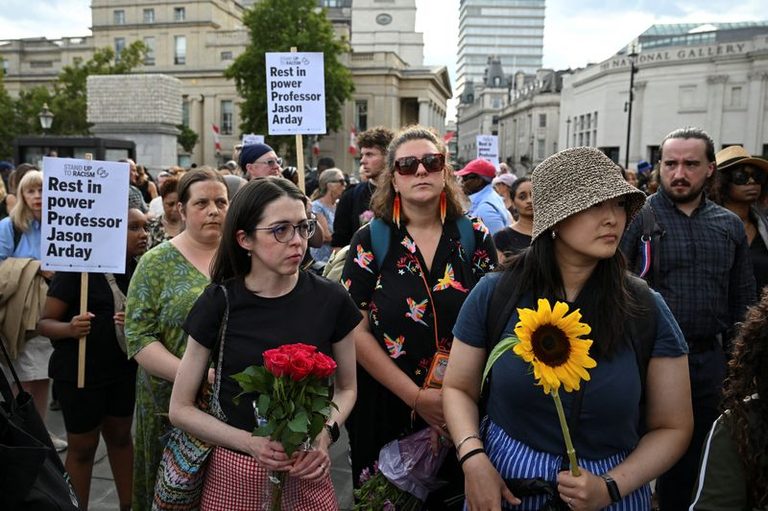
On Monday, central London’s Trafalgar Square became the focal point for a solemn gathering as thousands of people assembled to honor the memory of the late Jason Arday. Arday, a former sociology professor at the University of Cambridge, was found dead on Friday after a week‑long media storm surrounding accusations that he had plagiarized portions of his PhD thesis and misrepresented other aspects of his personal and professional life.
Vigil Organized by Stand Up to Racism
The vigil was organized by the campaign group Stand Up to Racism. Attendees carried flowers and placards, many of which read “Rest In Power Professor Jason Arday.” The gathering reflected a mix of grief, solidarity, and concern over the broader issues raised by the case, including academic integrity, media responsibility, and the treatment of Black scholars in elite institutions.
Background to the Controversy
Arday, once celebrated as Cambridge’s youngest Black professor, resigned from his post on August 5 after a former researcher publicly accused him of plagiarism in his doctoral dissertation. While Arday denied the allegations, he acknowledged that he had made mistakes in his career. The accusations quickly attracted intense media coverage, prompting scrutiny of his claimed achievements, his reported childhood struggles with autism, and even his alleged record of running 30 marathons in 35 days.
Family and Supporters Call for Compassion
Arday’s family released a statement on Friday describing him as a victim of misinformation and harassment. They urged the public and the press to consider the personal toll of relentless scrutiny. Cambridge professor Simon Baron‑Cohen, a supporter of Arday, told BBC radio that the professor had been “subjected to relentless scrutiny, including ridicule, discrediting absolutely every detail of his life,” and called for safeguards to protect vulnerable individuals.
University Response
Following the professor’s death, Cambridge University announced an internal investigation into the circumstances surrounding his appointment and the handling of the plagiarism allegations. University Chancellor Chris Smith emphasized the need to uphold academic integrity while also rejecting what he called a “racist feeding frenzy” targeting a single scholar. He told the BBC, “It is possible to believe in the importance of academic integrity and, when criticisms of plagiarism arise, ensure they are rigorously investigated, regardless of who is involved.”
Police Apology and Media Conduct
Britain’s Metropolitan Police issued an apology to a journalist who had been investigated after contacting Arday for comment on the plagiarism claims a year before the story became public. The apology highlighted concerns about press freedom and the appropriate role of law enforcement in media matters.
Public Reaction and Ongoing Debate
The vigil underscored the polarized public conversation that Arday’s case sparked. Critics argued that Cambridge had been overly eager to hire a Black academic without sufficient vetting, while supporters warned that the intense focus on Arday risked inflaming racial tensions and undermining legitimate discussions about academic standards. The event in Trafalgar Square, a historic site for public protest, served as a reminder of the delicate balance between holding scholars accountable and protecting individuals from undue harassment.
Looking Ahead
As Cambridge proceeds with its investigation, the university and broader academic community face pressure to demonstrate transparent processes for evaluating scholarly work. The vigil’s participants left with a shared hope that future discourse will prioritize both rigorous inquiry and compassionate treatment of individuals, especially those from historically underrepresented backgrounds.
Original reporting: Appleton, WI News Feed (HLL/CB) — read the source article.