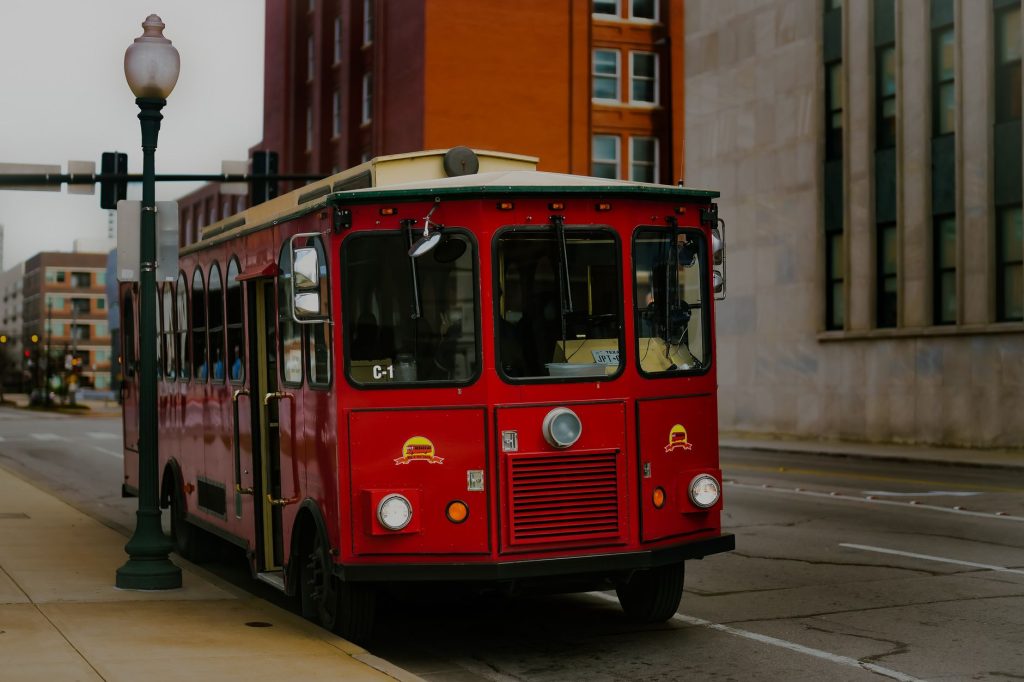
What do you do with a 1950s-era streetcar when the tracks are long gone? In Rockford, apparently, you restore it, mount it on a trailer frame, and keep running tours across the city for decades. The Rockford Trolley has been hauling passengers through neighborhoods most visitors — and plenty of locals — never think to explore, narrated by volunteers who treat civic history less like a lecture and more like gossip about old neighbors.
The trolley operates out of the Rockford Park District, typically running its seasonal schedule from late spring through fall. Tours depart from various staging points depending on the event — sometimes Riverview Park, sometimes downtown — and last roughly an hour to ninety minutes. Seating is bench-style, open-air on the sides, which means a July afternoon tour gets warm fast. Bring water. The breeze helps on the move, but stops in direct sun can be punishing. Fall tours, by contrast, are genuinely pleasant.
The guide narration is the whole point. Whoever draws the microphone on a given tour tends to be someone with actual skin in the material — a retired teacher, a longtime park district staffer, someone whose grandfather worked at one of the old furniture factories. The information is specific: this block was a Swedish enclave, that corner had three competing bakeries, the building that’s a tire shop now was once a vaudeville house. It’s the kind of detail that doesn’t make it into official history panels.
The route shifts depending on the theme. Some tours focus on Rockford’s industrial corridor along the Rock River, pointing out where the machine tool and hardware companies once dominated and what replaced them. Others cut through residential neighborhoods on the east and west sides, tracing the immigration waves that shaped the city’s architecture block by block. There are occasional evening tours tied to seasonal events — ghost-themed runs in October tend to sell out early, and families with kids treat them as a legitimate Halloween substitute.
Ticket prices are modest — typically in the $10–$15 range for adults, less for children — which makes it an unusually low-stakes way to spend an afternoon. Groups book private tours for reunions and corporate outings, and the trolley shows up at community events with some regularity. The Park District keeps the schedule updated on its website, though calling ahead never hurts; dates can shift based on volunteer availability.
It would be easy to dismiss the trolley as nostalgic kitsch — a novelty prop for people who like old things. But the riders who show up repeatedly aren’t there for the vehicle. They’re there because the city looks different at five miles per hour from an open bench seat, with someone pointing out what used to be where. Rockford has a habit of erasing its own past — buildings come down, storefronts change, whole industrial eras vanish inside a decade. The trolley runs against that tendency, at least for ninety minutes at a stretch.
First-timers should check which tour theme is running before they book. Not every route covers the same ground, and some are better suited to people with a genuine interest in local history versus those looking for a casual Sunday outing. Either way, the price of admission buys something hard to replicate: a version of Rockford seen slowly, out loud, by people who actually care how it got to be the way it is.