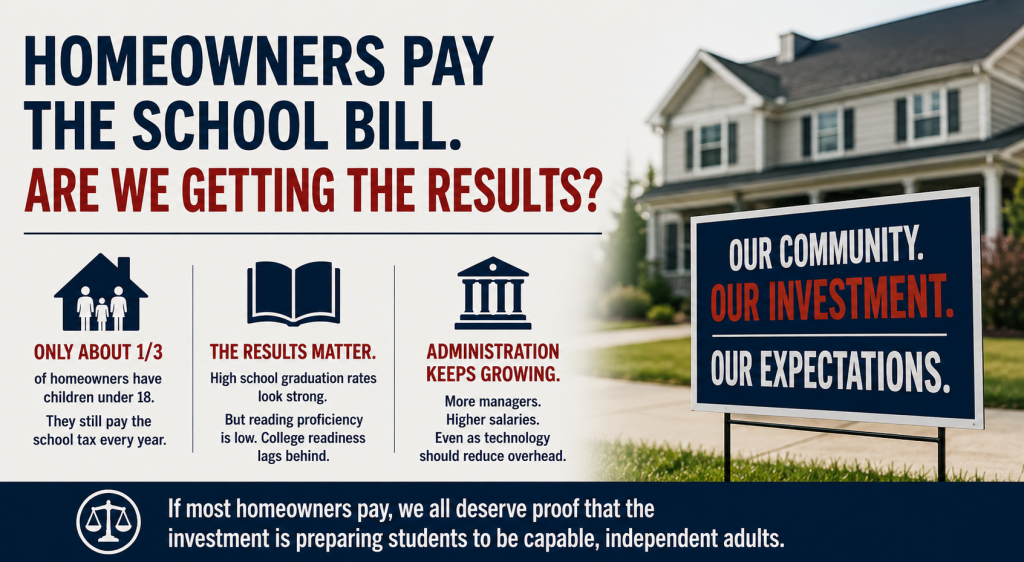
In Richardson, a minority of homeowners have kids under 18. They still carry most of the school tax. The question is what that money produces.
Richardson’s school-funding debate usually starts in the same place: districts say they are squeezed, homeowners say the bill is too high, and the conversation slides into emotion. The harder question is simpler. Who actually pays, what do we get back, and is the system built to notice when the return is weak?
Start with who carries the load. Local public schools in Texas are still financed, in large part, through residential property taxes. In a city like Richardson, that means the school portion of the bill lands on homeowners whether or not they have a child in the system. Census-style household data does not give a perfect “kids in RISD” count, but the available pattern is clear enough for a civic argument: only about a third of homeowners have children under 18. The rest are paying for a service they are not using — retirees, empty-nesters, young owners without kids, and households whose children already finished school.
That is not a claim that schools have no public value. Property values, workforce quality, and neighborhood stability all benefit from decent schools. It is a claim about concentration. A minority of owner-occupied homes currently have school-age children. The majority still write the check. For some long-time owners, the monthly property-tax payment now exceeds the mortgage. When that happens, the tax is no longer a side cost of housing. It is the housing cost.
When people hear “raise the local sales tax and dedicate it to schools,” the first reaction is monthly pain. Sales tax shows up at the register. Property tax is escrowed and easier to treat as weather. The silence that follows a second fact is more interesting: the current system already puts a large cost on homeowners, most of whom do not have children under 18. Spreading the same total across a broader base would not make education free. It would make the bill visible to renters, shoppers, and businesses as well as owners. People manage other people’s money less carefully than their own. A broader tax does not guarantee reform. It does increase the number of residents who feel the cost and ask what the money buys.
What it buys is the real test. Texas high school graduation rates look strong, near 90 percent. Proficiency does not. On the most comparable national measure, only about 28 percent of Texas fourth-graders scored at or above proficient in reading in 2024. College-readiness and actual college completion lag the feel-good graduation number. Spending has risen for a decade. The skills that determine whether a graduate can speak clearly, handle basic math, and hold a job have not risen with it.
That is the standard that matters. Standardized tests are imperfect. They are still a signal of the basics. If a student cannot communicate and cannot do ordinary quantitative work, the labor market will not pretend otherwise. Adults either support themselves or they rely on someone else. In a country with the resources of the United States, an education system that leaves large numbers of graduates short of that line has failed its most basic social purpose.
Defenders of the system often grant that the metrics are flawed and then stop. They rarely offer a replacement that is public, comparable, and hard to game — later earnings, employer readiness, independent writing and problem-solving, value-added growth from a student’s starting point. Soft claims about the “whole child” are not a substitute for evidence that graduates can stand on their own.
The overhead makes the outcome gap harder to accept. Several Texas superintendents now earn more than the president’s $400,000 salary, with top packages in the $500,000s. The statewide median is near $157,000. Boards set those contracts. Taxpayers live with them.
The same pattern showed up this month at the Texas Education Agency. A State Auditor’s Office review found TEA had one manager for every 3.5 staff members as of August 31, 2025. State law caps large agencies at one manager per 11 non-managerial employees unless the Legislative Budget Board approves an exception. TEA had not obtained that approval. Management headcount grew 38 percent from 2021 to 2025; non-management grew 12 percent. Management pay rose about 64 percent, to roughly $44.7 million. The statute has no real penalty. After the finding, the agency asked for a waiver.
AI makes the org chart look older still. TEA already uses automated engines to score most STAAR written responses and cut a large seasonal grading workforce. Districts are adopting classroom tools for lesson plans and paperwork. None of that flattened TEA’s management layer. The technology that should reduce coordination work arrived. The manager count went up anyway.
None of this requires pretending schools are worthless or that every dollar is wasted. It requires dropping the guilt script. Homeowners without children in the system are not villains for asking why their tax bill outruns their mortgage. Parents are not villains for wanting schools funded. The conflict is distribution and performance. A funding method that hides the cost on a minority of households, combined with weak public measures of whether graduates can support themselves, will keep producing the same fight.
If Richardson is going to keep paying at this level, the product has to be graduates who can function independently. If the system cannot show that, the next argument is not for more of the same tax on the same owners. It is for a broader base, a harder outcome test, and an administrative structure that shrinks when the tools to shrink it already exist.