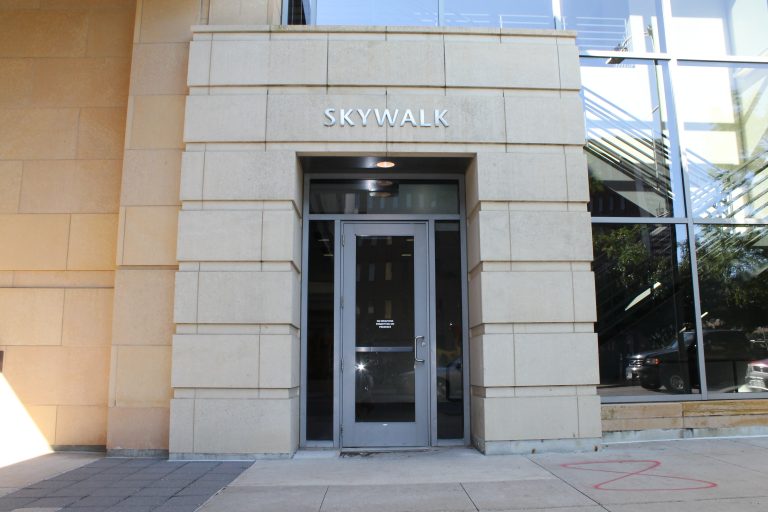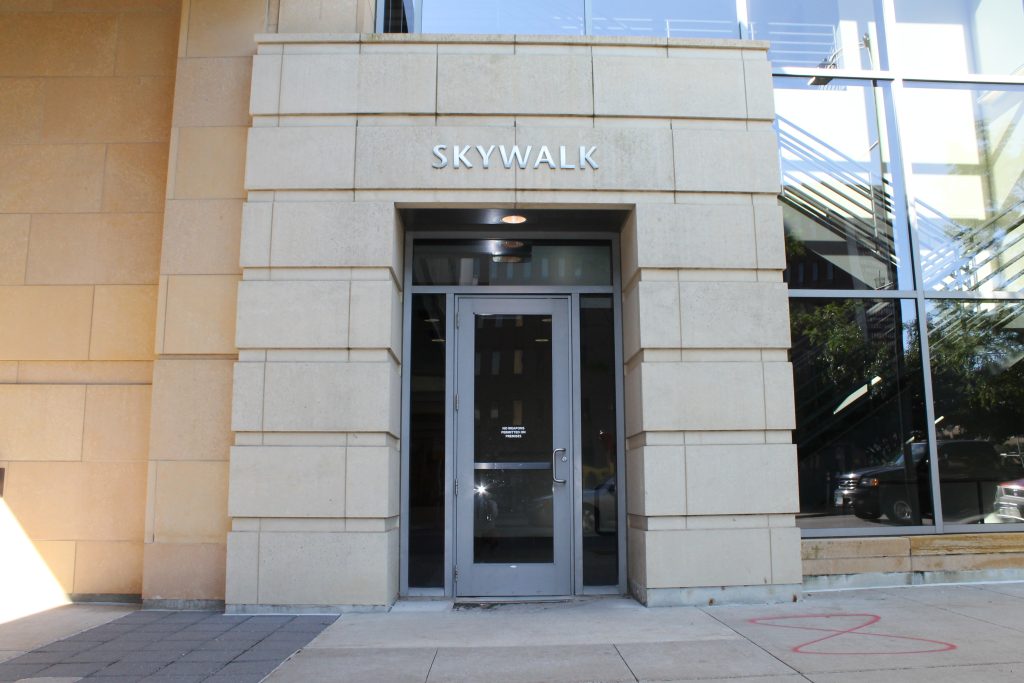
The Des Moines Skywalk System is one of the longest climate-controlled urban pedestrian networks in the country, and most people who use it every day have never stopped to think about that.
Cheryl Hagen has. She’s worked downtown for nineteen years, the last twelve of them at a financial firm near the corner of Sixth and Locust. She walks the skywalk every weekday — sometimes twice, sometimes three times. She knows which sections get cold in January near the older connectors. She knows which coffee cart closes early on Fridays. She knows which stretch over Grand Avenue gives you a view of the Capitol dome that most tourists never see because they’re looking at their phones.
“People think it’s just a way to avoid weather,” she said one morning, waiting for her order at a sandwich counter near the Ruan Center. “But it’s a whole world up here. I’ve had the same conversations with the same people for years. You just don’t know their names.”
The skywalk connects more than sixty blocks of downtown Des Moines across roughly four miles of enclosed walkways, linking office towers, hotels, the convention center, parking ramps, and a handful of food counters and small shops. It runs roughly between the east side of the Des Moines River and Fourteenth Street, and from the interstate on the south up toward the library district to the north. The system was built in stages starting in the 1970s and kept growing as downtown did.
On a February afternoon when it’s twelve degrees and the wind is straight out of the northwest, the skywalk is not an amenity — it’s a lifeline. Office workers move through it with the practiced efficiency of people who’ve memorized every turn. Delivery workers push carts. The occasional visitor stops to look out at street level, trying to get their bearings.
But the skywalk is worth exploring even when the weather is fine. Take a Tuesday in October and walk the full loop without an agenda. The views shift constantly. Some sections are wide and bright with tall windows. Others feel narrow and institutional, with drop ceilings and linoleum that hasn’t changed since 1985. That contrast is part of what makes it honest — this was never a vanity project. It was built for utility, and it still functions that way.
There’s no admission, no tour, no app. You just walk in. The main entry points are through hotels like the Marriott and the Embassy Suites, through the Ruan Center and 801 Grand, and through several parking structures. Maps are posted at major junctions, though seasoned walkers like Cheryl rarely need them.
The food options inside are modest and practical — a couple of delis, a smoothie counter, a coffee spot or two, nothing that would make a restaurant critic’s notebook. But that’s not the point. The skywalk is at its best when you stop treating it as infrastructure and start paying attention to it as a place. The people moving through it on a Monday morning — nurses, lawyers, city workers, hotel staff — are as much a part of downtown Des Moines as anything on the street below.
Cheryl finishes her sandwich and gathers her bag. She’ll be back in an hour for her afternoon loop. “I could take the stairs and go outside,” she said. “But then I’d miss it.”