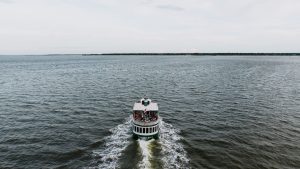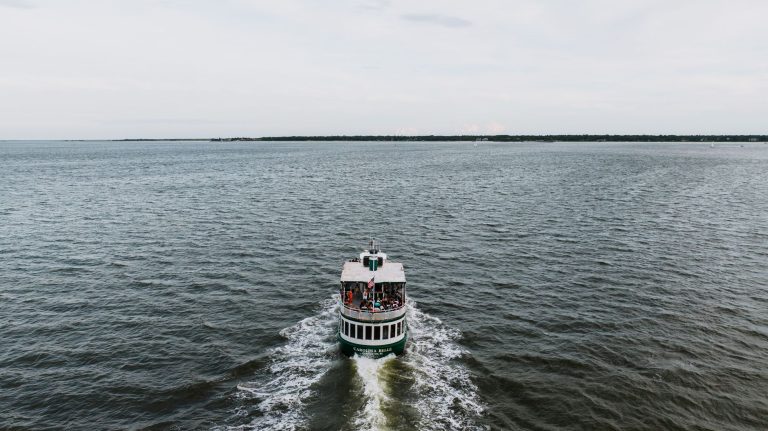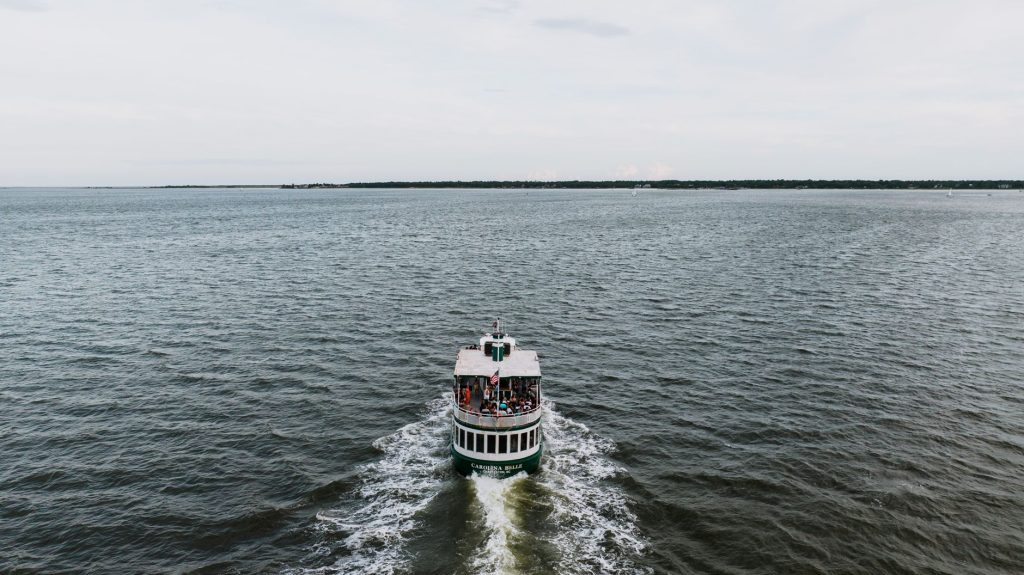
The ferry leaves from Inlet Point Marina on the Isle of Palms side, and the ride takes about fifteen minutes across Dewees Inlet. That part sounds routine. What doesn’t quite register until you step off the boat is that Dewees Island has no paved roads, no commercial development, no cars, and no bridge. The 1,206 acres of maritime forest, salt marsh, and beach sit twelve miles northeast of Charleston and operate as a private residential community governed by its own conservation covenant. There are roughly 150 home sites, most of them occupied seasonally, and a nature center that opens to day visitors on a limited basis.
The island runs on golf carts and footpaths. Residents own their own carts; visitors on naturalist-led tours walk or hitch a ride. The quiet registers quickly. There’s no ambient traffic hum, no generator noise from a marina full of charter boats. The loudest things tend to be the wind through the longleaf pines and, in nesting season, the racket from the rookery near the freshwater lake.
Loggerhead sea turtles nest on the ocean beach from late May through August. The island’s conservation staff monitors nests, and guided beach walks during this window give visitors a closer look at the process than most people expect — not from a roped-off distance, but actually near the dunes while staff mark and assess fresh crawls. The rookery near Lake Timicau holds herons, egrets, anhingas, and roseate spoonbills in numbers that feel almost theatrical from the boardwalk overlook. The freshwater lake itself is good for alligators, and they are not shy about it.
Day visits require advance arrangement through the Dewees Island Nature Center, which runs a small but serious interpretive program. Access is not walk-up. Tours typically run on select dates between spring and early fall, and the capacity is kept small — usually ten to fifteen people per trip. Cost for a guided day visit runs in the range of $40 to $60 per adult, depending on the program, with some variation for children. The ferry fee is bundled in.
The expectation, for someone accustomed to Lowcountry eco-tours, is that this will feel like a staged excursion with scripted talking points about fiddler crabs. It doesn’t. The island is functioning habitat, not a managed attraction, and the guides — several of them have worked on conservation research there for years — treat visitors accordingly. The difference between being handed a brochure and being shown something real is felt almost immediately.
Bring water, sunscreen, and shoes that can handle sand and mud. The nature center has minimal amenities. Cell service is unreliable, which after an hour or so stops feeling like an inconvenience and starts feeling like the point. The return ferry runs on a schedule, and missing it is not a small problem, so the tours are structured to keep the group on track.
Dewees occupies a genuinely unusual position: a barrier island close enough to Charleston to reach in a morning that has remained, by deliberate legal design, almost entirely wild. The conservation easements are permanent. The covenant is not marketing language. What exists there now is what will exist there in forty years, which is not something that can be said about much of the South Carolina coast.