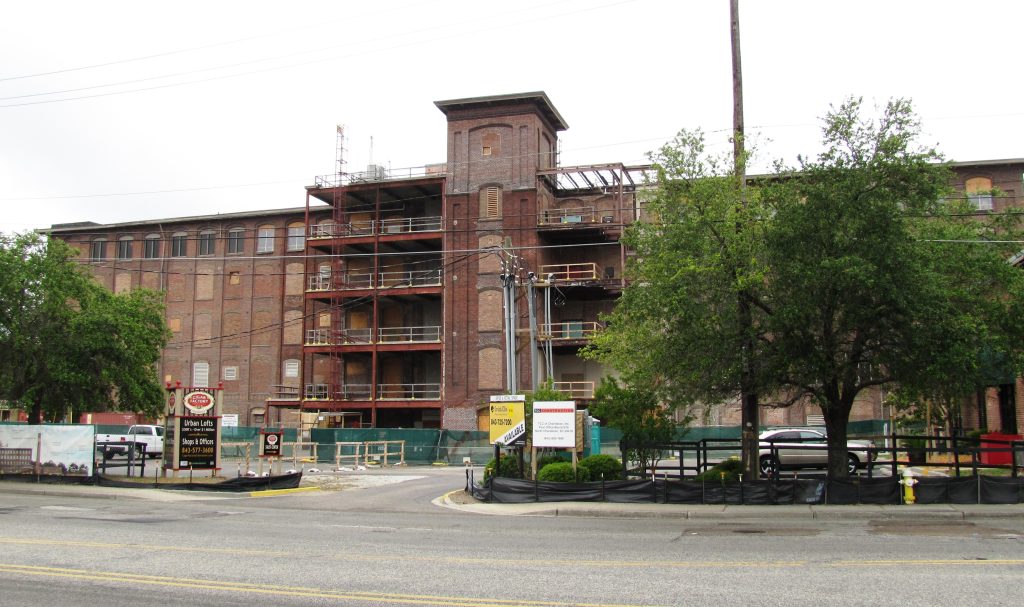
The building opened in 1882 as a fertilizer warehouse before it became something far more consequential — the American Tobacco Company’s largest cigar-rolling operation on the East Coast. At its peak in the mid-twentieth century, roughly three thousand workers, the majority of them Black women, rolled cigars on the floors above what is now East Bay Street. In 1945, those same workers launched one of the earliest civil rights labor strikes in the American South, walking off the job to demand equal pay. The Cigar Factory did not hide from this history when it was redeveloped. It kept the name.
Today the building sits at 701 East Bay Street on the edge of the Eastside neighborhood, a few blocks north of where the tourist maps tend to end. The brick exterior is original — four stories of late-Victorian industrial architecture that looks exactly like what it is. The interior has been converted into office space, event venues, and a handful of retail and food tenants, but the bones of the place are intact: heavy timber framing, original hardwood floors worn smooth in the middle of old walking paths, windows that let in serious afternoon light.
What makes a visit worthwhile on a weekday morning, specifically, is how quiet it is before the office workers arrive in force. You can walk the first-floor corridor and read the historical markers at your own pace. The signage covers the 1945 strike in real detail — the names of the workers who organized, the demands they made, what they won and what they didn’t. It’s the kind of local history that rarely makes it into the tour scripts on the lower peninsula, and it’s told plainly, without softening.
The building also anchors a stretch of East Bay that has changed faster than almost any other part of Charleston over the past decade. The Ravenel Bridge is visible from the parking lot. The old Morrison Drive corridor, now rebranded as the NoMo district by real estate interests, runs just to the west. Standing in front of the Cigar Factory and looking around, you can see development pressure from every direction. The building itself is one of the few fixed points.
There’s no admission fee to walk through the common areas. If you want to spend money, there are a few tenants worth your time — a coffee operation on the ground floor does well by its cold brew, and on most weekday mornings you can get a cup and sit near the original loading dock doors while they’re propped open. It costs about what coffee costs anywhere in Charleston now, which is more than it should be but less than you’d pay on King Street for the same thing with a longer line.
The Cigar Factory is not a museum with hours and a gift shop. It’s a working building that also happens to carry a significant amount of history on its back. The historical markers are worth reading slowly. The architecture is worth looking at carefully. And the story of the women who worked those floors and then refused to keep working until the company paid them fairly is worth knowing before you spend a weekend eating and drinking your way through a city built on labor that was rarely fairly compensated.
Give it a Tuesday morning, an hour, and your full attention.