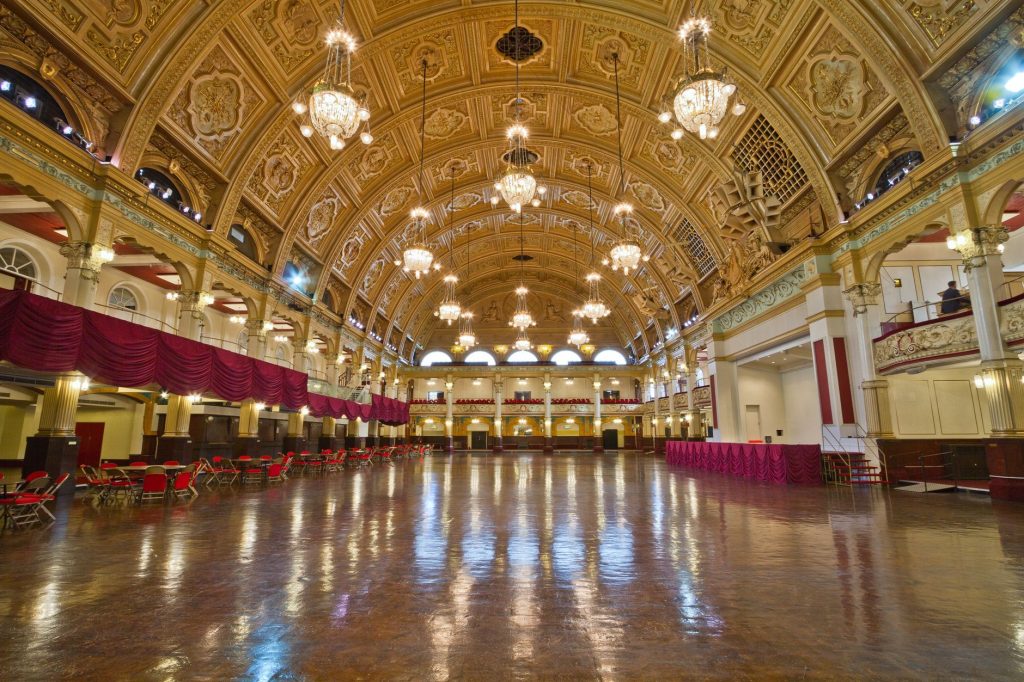
There is a particular kind of thrill that comes from walking into a room and realizing, within about thirty seconds, that you have stumbled onto something genuinely irreplaceable. That is exactly what happened to me the first time I climbed the worn wooden stairs of the Polish National Home on Bridgeport’s East Side, pushed open a set of heavy doors, and stepped into a ballroom that looked — and felt — like it had been preserved in amber since 1929.
Bridgeport’s East Side is one of those neighborhoods that does not announce itself loudly. It sits east of downtown along East Main Street, a corridor of triple-deckers, parish churches, and storefronts that have quietly held their ground through every economic cycle the city has thrown at them. The Polish National Home at 35 Pulaski Street anchors a corner of this neighborhood like a civic monument, because for the community that built it, that is precisely what it is.
The ballroom on the upper floor is the reason to make the trip. It is a full-scale, old-world dance hall — high ceilings with original plasterwork details, a hardwood floor that has absorbed a century of polkas and waltzes and wedding receptions, a proper stage at one end, and a bar that operates with the cheerful efficiency of a place that has been pouring for regulars since before most of its customers were born. The space seats several hundred people comfortably, and on the nights when the hall is rented for a community event or a live music evening, it fills with an energy that feels nothing like a manufactured nightlife venue. It feels like actual life being lived by actual people who love where they come from.
The programming varies — check the hall’s calendar before you go, because some evenings are private events for members of the Polish community organizations that still use the building regularly. But public events do happen here: heritage festivals, polka dances (yes, real ones, and yes, you should absolutely try), fundraiser dinners, and the occasional live band night that pulls an unexpectedly wide crowd. When the floor is open and the music is up, the room transforms in a way that a photograph cannot fully capture. You have to be standing on that floor to understand it.
Part of what makes the Polish National Home so compelling is the straightforward sincerity of the place. There is no ironic rebranding here, no artisanal cocktail menu dressed up to look vintage. The kielbasa is real kielbasa. The pierogi, when they are served at events, taste like someone’s grandmother made them — because someone’s grandmother probably did. The décor has not been curated; it has simply accumulated, and the result is an authenticity that no designer could reproduce on purpose.
If you care about American urban history, immigrant community architecture, or simply the pleasure of dancing in a room with great bones and a crowd that genuinely wants you to have a good time, put this on your Bridgeport itinerary. Come on a night when the hall is open to the public, introduce yourself to someone at the bar, and let the evening take you wherever it goes. The Polish National Home has been doing exactly this for a very long time, and it is not finished yet.
Getting there is simple — East Main Street is accessible by car and by the CT Transit Route 2 bus, and parking on the surrounding streets is generally easy. Dress comfortably, bring some cash for the bar, and leave your expectations at the door. What you find inside will be better than whatever you were anticipating.