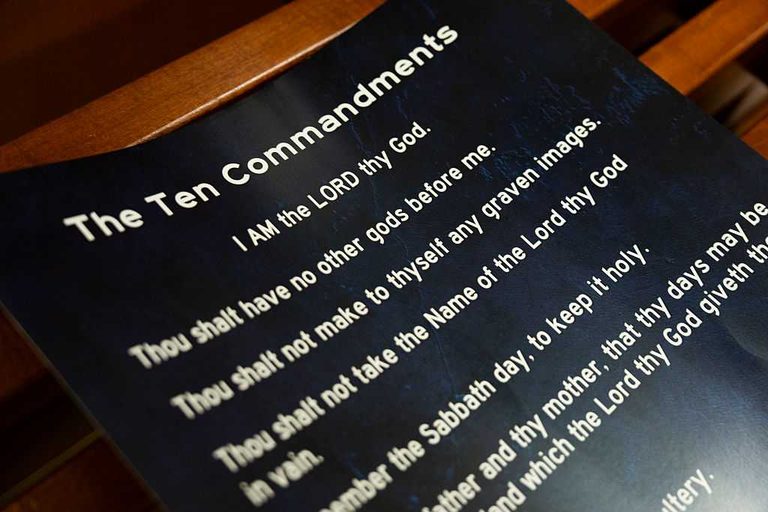
Texas families, represented by the American Civil Liberties Union and other advocacy groups, filed a petition on Monday asking the U.S. Supreme Court to review the state’s law that obligates public schools to display the Ten Commandments. The request follows a narrow 9‑8 decision by the conservative‑leaning 5th U.S. Circuit Court of Appeals that upheld the law earlier this year.
Background of the Texas statute
Signed by Republican Governor Greg Abbott and effective as of September 2025, the Texas law requires school districts to post the Ten Commandments when a donor provides the posters. The law does not mandate recitation or affirmation of the scripture; it merely permits the display of the religious text. Since the law took effect, boxes of posters have been delivered to classrooms across the state, which serves roughly 5.5 million students.
Legal challenge and constitutional arguments
The petitioners argue that the statute violates the First Amendment’s Establishment Clause, which prohibits government actions that favor a particular religion. In their brief, the families wrote, “The question of whether a state may impose scripture on impressionable, captive‑audience children — for nearly every hour of every school day, for up to thirteen years — implicates the most fundamental guarantees of the First Amendment and our Nation’s highest ideals.” They contend that singling out Scripture for display in public schools amounts to state‑sponsored religious expression.
Attorney Heather Weaver of the ACLU emphasized the broader relevance, stating, “This is an issue of nationwide importance because a number of states have been considering these laws in recent years.” Arkansas, Louisiana, and Alabama have enacted comparable statutes, and a Supreme Court ruling could set a precedent that reaches those states.
Recent court history
Earlier this year, the 5th Circuit reversed lower‑court orders that had blocked several Texas districts from posting the Ten Commandments. The appellate court noted that “no child is made to recite the Commandments, believe them, or affirm their divine origin,” suggesting the law does not compel religious practice. However, the narrow split among the judges indicates a deep division over the constitutional analysis.
In 1980, the U.S. Supreme Court struck down a similar Kentucky law, finding it served a plainly religious purpose without a secular justification and therefore violated the Establishment Clause. The current petition asks the high court to clarify whether the Texas approach is consistent with that precedent.
Potential impact on Arkansas and other states
Arkansas recently passed its own Ten Commandments requirement for public schools. If the Supreme Court rules that Texas’ law is unconstitutional, the decision could invalidate Arkansas’ statute as well, prompting local school boards to remove the posters and reassess any related policies.
The Texas Attorney General’s office has not responded to requests for comment.
What’s next?
The Supreme Court will decide whether to grant certiorari, the process that determines if it will hear the case. If the Court takes the case, it could become a landmark decision on the balance between religious liberty and the constitutional separation of church and state in public education.
For parents, educators, and faith‑based groups across the region, the outcome will shape how religious texts are treated in classrooms and may influence future legislation in multiple states.
Original reporting: 40/29 / KHBS (NW Arkansas) — read the source article.