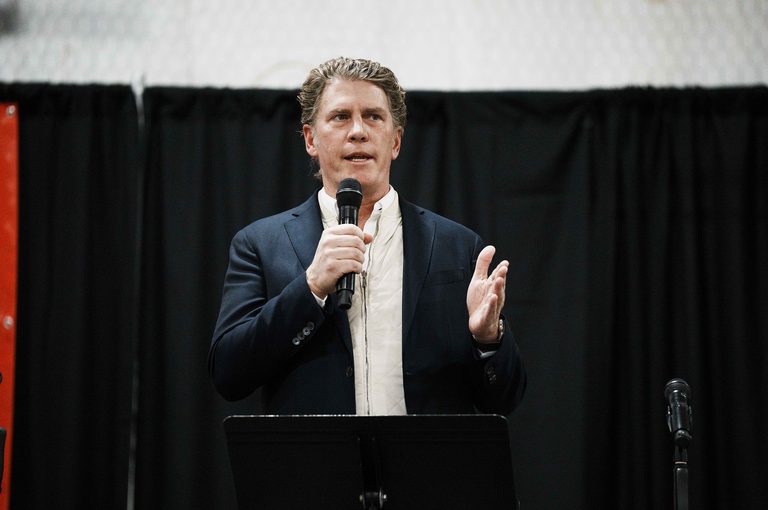
Bo French, a Republican hopeful for the Texas Railroad Commission, drew national attention this week after posting a racist comment about a group of South Asian students at a Longhorns football game. The post ignited condemnation from GOP leaders, including Sen. John Cornyn, and prompted former Bush adviser Karl Rove to say he would vote for the Democrat in the race.
Industry’s muted response
Despite French’s potential role in regulating the state’s oil and gas sector, the industry’s biggest players have largely stayed quiet. The Texas Tribune reached out to ExxonMobil, Chevron, Occidental Petroleum and other leading companies via email, phone and media request forms; none offered a comment.
The Texas Oil and Gas Association’s Political Action Committee (TXOGA PAC) had endorsed French just days before the tweet. After the controversy, TXOGA PAC issued a statement: “TXOGA PAC unequivocally and without reservation condemns the recent tweet posted September 13th on X by Bo French. Respect is a cornerstone of our industry’s core values,” said Todd Staples, treasurer of the Texas Oil and Gas Association Good Government Committee.
Financial backing and shifting support
French was not TXOGA’s original preferred candidate. Earlier this spring the PAC backed incumbent Commissioner Jim Wright, contributing roughly $100,000, with Exxon adding $20,000 and other executives chipping in tens of thousands. PAC contributions from Diamondback Energy and Chevron Employees each gave Wright $10,000.
Political science fellow Mark Jones of Rice University’s Baker Institute noted that French is “toxic in so many different ways that the oil and natural gas industry does not want to be openly associated with him.” Jones warned that aligning with French could jeopardize business operations and workforce relations, especially since many Texas oil firms employ illegal immigrant workers and conduct business in the Middle East—groups French has repeatedly targeted.
Policy positions remain vague
The Railroad Commission, a 135‑year‑old agency, regulates drilling, mining, pipelines, carbon‑capture permits, orphaned wells and the underground injection of produced water. It manages a half‑billion‑dollar budget but has no jurisdiction over immigration, university policy or LGBTQ+ issues.
French’s campaign website now touts lower gas and energy costs, blaming high prices on environmental regulations. He promises to “push for policies that will expand oil and gas production, and make life more affordable in Texas.” However, he has offered no concrete plan for how to achieve these goals, nor has he detailed how he would fund his suggested redirection of diversity‑initiative money toward orphan well remediation.
At the March Conservative Political Action Conference, French called for the deportation of 100 million people—about a third of the U.S. population—and suggested the government should deport Native Americans. Such statements have raised concerns among industry executives who prioritize regulatory predictability over cultural‑war rhetoric.
Donors and future financing
Individual donors with oil‑industry ties have contributed to French’s campaign. Midland executive Miles Boldrick and CrownQuest Operating’s Luke Dunn each gave tens of thousands of dollars, with Dunn reportedly contributing at least $50,000. Alex Williamson, president of ANW Minerals, also donated $50,000. The Texas Freedom Fund for the Advancement of Justice, a PAC backed by oil magnates Tim Dunn and Farris Wilks, has already poured nearly $500,000 in cash and spent $300,000 on ads for French.
The next round of campaign‑finance reports, due in early October, will reveal whether additional oil companies have pledged money to French’s race.
Implications for the Railroad Commission
While the Permian Basin continues to supply nearly half of U.S. oil, the industry’s historical support for Republican candidates does not automatically translate to backing French. Political science professor Kimi King of the University of North Texas explained that oil executives care more about regulatory expertise, predictability and policy outcomes than cultural‑war alignment, which may explain their cautious stance.
As the primary election approaches, Texas voters will have to weigh French’s incendiary rhetoric against his vague policy proposals and the oil and gas sector’s evident reluctance to endorse him outright.
Original reporting: Texas Tribune (HLL/CB) — read the source article.